




- Jul 22, 2026
- Featured Insights
A Parent's Guide to 2D Shapes and 3D Shapes: Hands-On Learning Math at Home
Your child picks up a wooden block, holds it up next to a drawing of a square on the page, and asks, "Are these the same?" They look exactly alike in your child's eyes—both have four sides, both look like squares.
That moment of comparison is an early spark of geometric thinking. If you can meet that curiosity with the right vocabulary and hands-on experience, you can easily turn your kitchen table into a geometry classroom.
This guide walks you through the essentials, from clear definitions to practical activities, so you can support your child's shape learning with confidence
"Is This Block a Square or a Cube?" Navigating Everyday Shape Questions
The Moment Kids Start Noticing Dimensions Around Them
Learning geometry often begins in small, unscripted moments. Based on our experience, a 4-year-old notices that a cracker looks like the triangle on a puzzle piece. A 7-year-old often realizes a tissue box is not just a rectangle because it has a top, a bottom, and four sides all at once. These observations indicate that a child's brain is actively building a framework for understanding space and dimension.
What children are doing in these moments is comparing plane figures with solid figures. They are sensing that some shapes exist only as flat outlines, while others occupy real physical space.
Turning Simple Curiosity into Hands-On Learning Opportunities
When a child asks if an object is a square or a cube, a helpful approach is to reply with a question: "What do you notice that is different about them?" Let your child run a finger along the flat drawing and then feel all six sides of the block. That physical comparison provides immediate context.
Hands-on learning math works because young children process the world through touch and movement before they process it through language. When a child holds a cylinder, spins it, and feels that it has no corners, they are building a sensory memory that helps anchor the mathematical concept.
Why Understanding Flat vs. Solid Objects Matters Early On
Learning to distinguish flat shapes from solid objects forms the foundation for systematic observation. It trains children to notice what makes things similar, what makes them different, and why those distinctions matter.
In the U.S. Common Core math standards, students generally begin comparing 2D shapes and 3D shapes in kindergarten and first grade. By second grade, they are expected to identify defining attributes like faces, edges, and vertices (though specific curriculum timelines may vary by district). The real value shows up later when a child can look at any problem and ask, "What are the properties here?" That is a broad thinking skill, not just a geometry requirement.
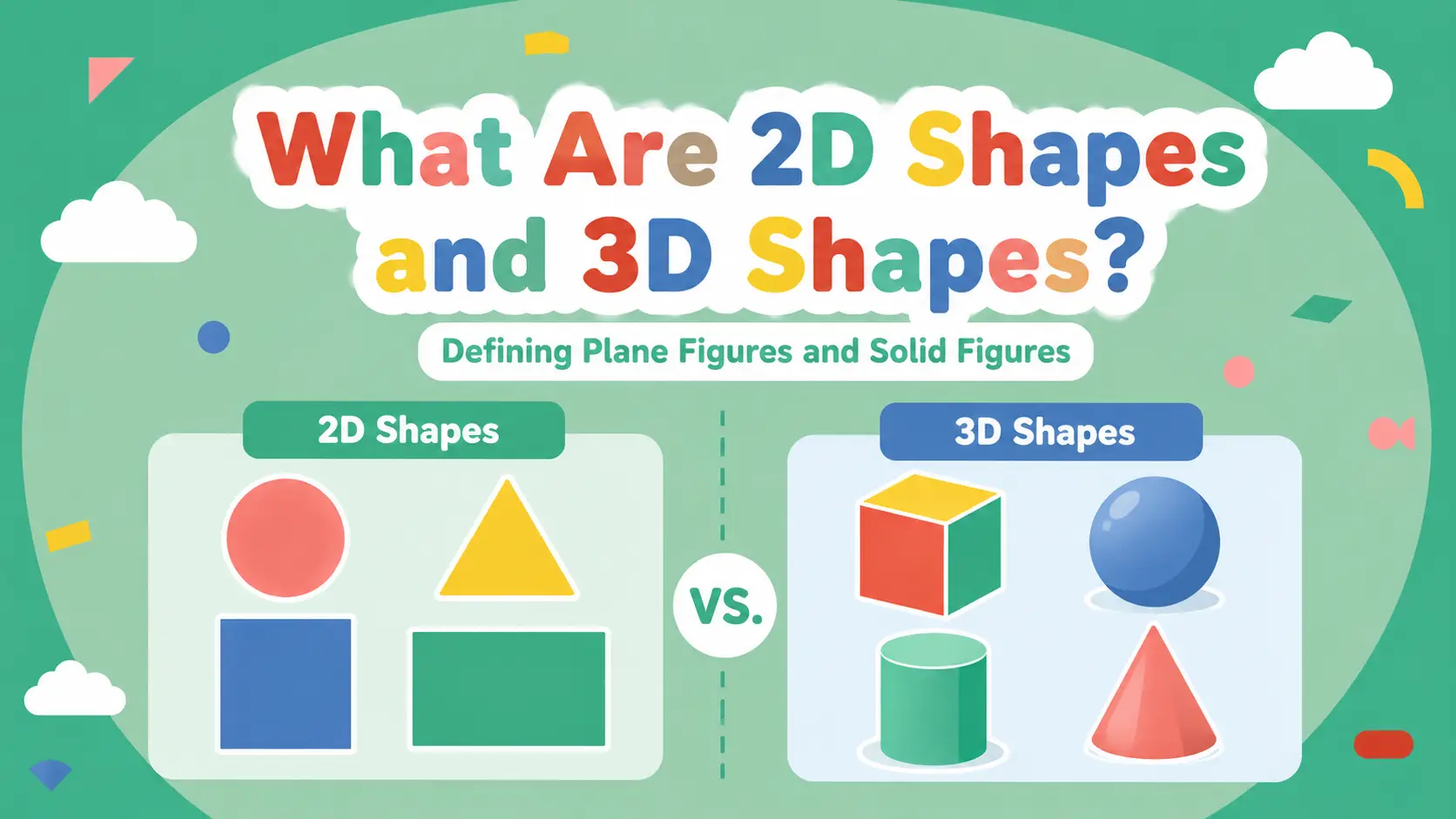
Defining Plane Figures and Solid Figures: What Are 2D Shapes and 3D Shapes?
At Sunstart, when we discuss cultivating mathematical capabilities and thinking, we refer to the specific habit of observing carefully, asking precise questions, and reasoning from what you see to what you can conclude. Shape learning is one of the earliest and most concrete places to practice this process.
Two Dimensions: Exploring Length and Breadth in Flat Shapes
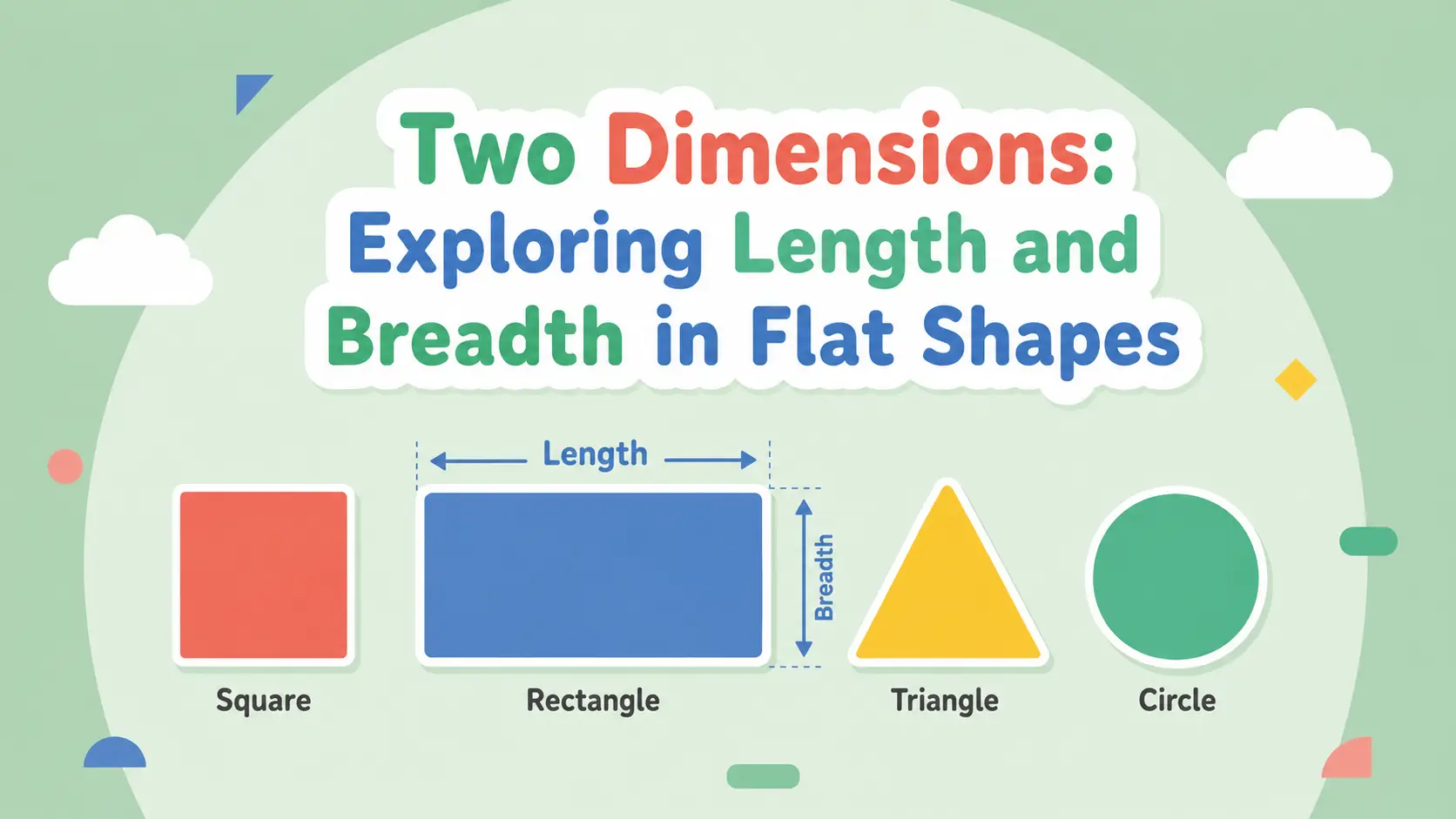
2D shapes are two-dimensional figures that only have length and width. When children draw a circle, triangle, or square on paper, they are encountering 2D shapes. These figures exist on a flat surface, without any outward thickness, and therefore only exhibit two dimensions: length and width.
The first 2D shapes children typically recognize include circles, triangles, squares, and rectangles. With accumulated observation and exploration, they will further encounter polygons such as pentagons, hexagons, and octagons, and begin to compare the number of sides, angles, and appearance characteristics of different shapes. For example, a triangle has three sides and three angles, a square has four sides of equal length and four right angles, and a circle is composed of a continuous curve.
Everyday objects such as clocks, windows, road signs, and floor tiles can help children build their concept of 2D geometry from real-world contexts.
Adding the Third Dimension: How Depth and Height Create 3D Shapes
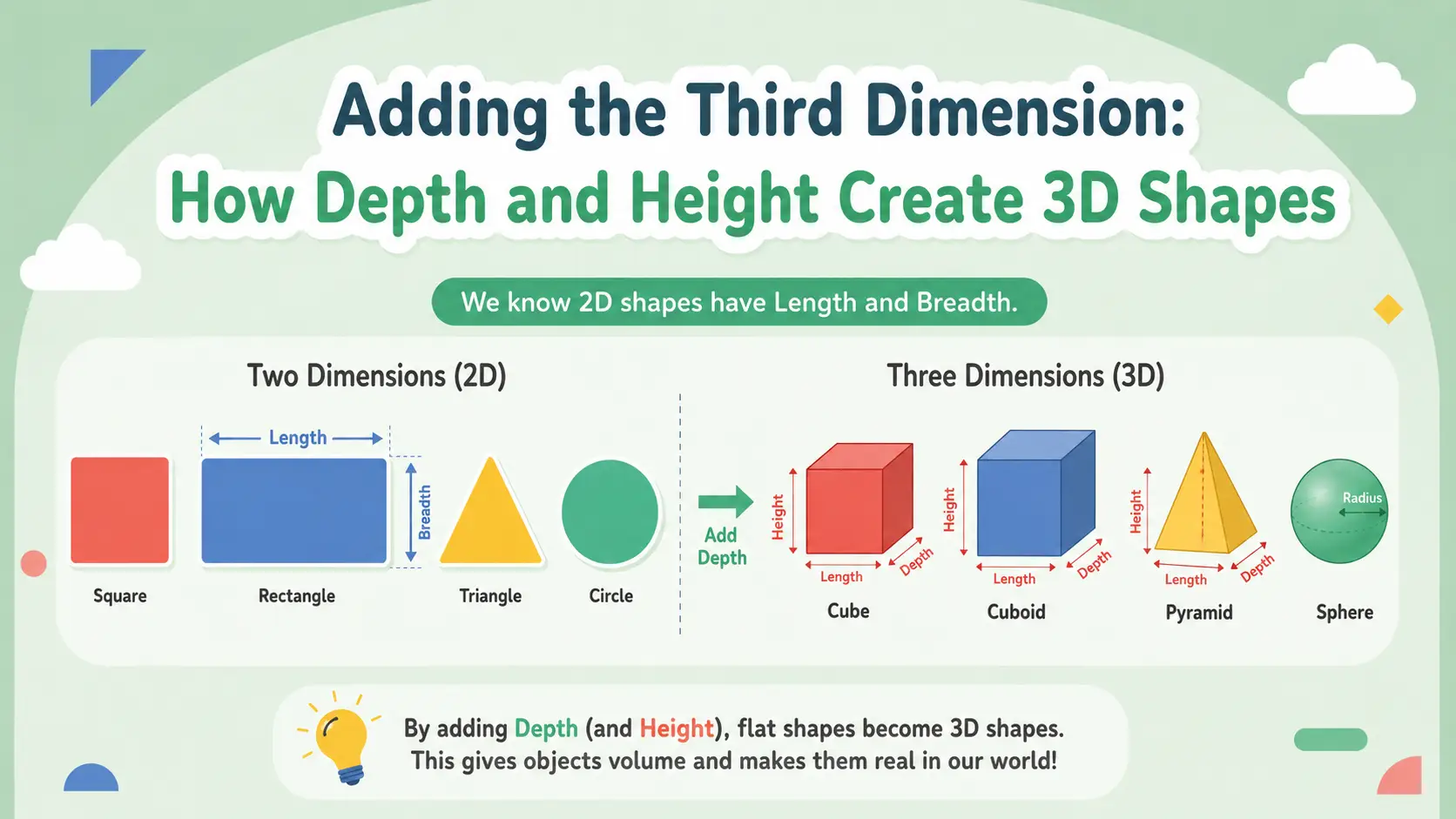
When a shape possesses depth (or height) in addition to length and width, it becomes a 3D shape. Unlike two-dimensional shapes, 3D shapes occupy actual space, allowing us to observe them from different angles and see different faces.
Familiar objects for children, such as building blocks, balls, cardboard boxes, and jars, are common 3D shapes. Through observing and manipulating these objects, children gradually understand the differences between three-dimensional and two-dimensional shapes. For example, a cube consists of 6 faces, 12 edges, and 8 vertices; a sphere, however, has no edges or vertices, but is composed of a continuous curved surface.
In learning about 3D shapes, children not only recognize the names and characteristics of different three-dimensional shapes but also begin to think about how objects appear when viewed from different directions and the spatial relationships between their faces. These experiences help children develop spatial awareness and a three-dimensional concept, laying the foundation for subsequent geometry learning.
Connecting Definitions to Cognitive Development (How Sunstar Cultivates Math Abilities)
We have observed in our work that children often learn the words "2D" and "3D" long before they truly understand the concept. They can recite that a cube has 6 faces without being able to explain why a drawing of a cube differs from an actual block.
This is why our educational approach moves through four stages: observe, question, think, and express. When a child holds a cylinder and a teacher asks, "Where are the edges on this shape?" the child runs their fingers around the curved surface and discovers there are none. That moment of self-discovery helps the child practice the thinking process of observation leading to a conclusion.
Exploring Properties: A Simple Comparison of 2D Shapes and 3D Shapes
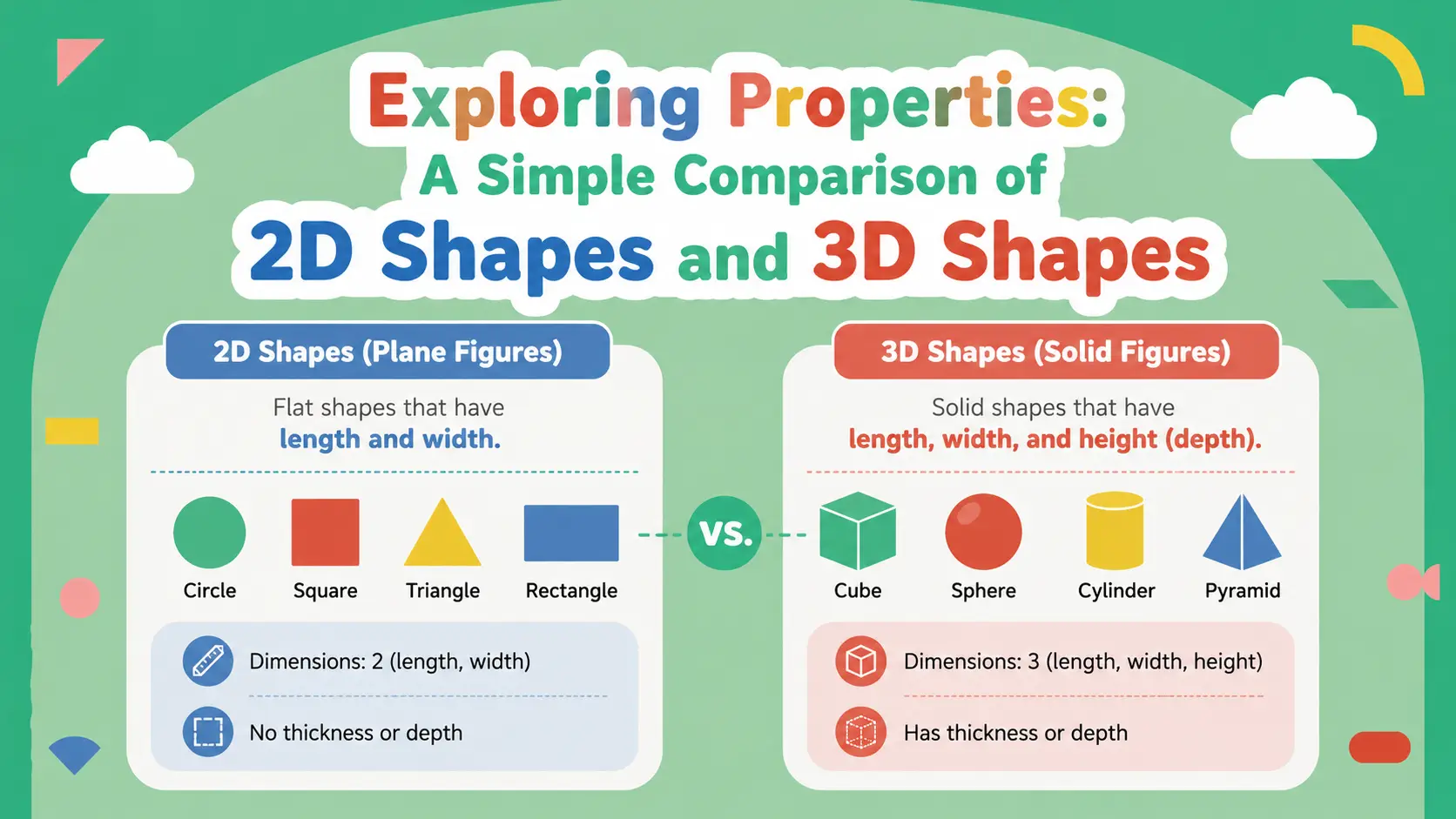
Knowing that 2D shapes are flat and 3D shapes are solid is just the starting point. The richer conversation happens when children start comparing their specific properties.
Essential Geometric Properties: Counting Angles, Faces, Vertices, and Edges
For 2D shapes, the two key properties are the number of sides and the number of angles. These always match: a triangle has 3 sides and 3 angles, while a pentagon has 5 sides and 5 angles. An angle is the space formed inside a corner.
For 3D objects, properties expand to faces, edges, and vertices. A face is one flat surface. An edge is the line where two faces meet. A vertex is the point where three or more edges come together.
From Circles to Spheres: A Quick Visual Comparison Chart
The table below outlines common flat and solid figures, serving as a quick reference guide.
|
Shape |
Type |
Dimensions |
Key Properties |
Everyday Object |
|
Circle |
2D |
Length, breadth |
0 sides, 0 angles, curved boundary |
Clock face, coin, wheel |
|
Triangle |
2D |
Length, breadth |
3 sides, 3 angles |
Slice of pizza, yield sign |
|
Square |
2D |
Length, breadth |
4 equal sides, 4 right angles |
Sticky note, tile |
|
Rectangle |
2D |
Length, breadth |
4 sides, 4 right angles, opposite sides equal |
Book cover, door panel |
|
Pentagon |
2D |
Length, breadth |
5 sides, 5 angles |
Home plate in baseball |
|
Sphere |
3D |
Length, width, height |
1 curved surface, 0 edges, 0 vertices |
Basketball, orange, marble |
|
Cube |
3D |
Length, width, height |
6 faces, 12 edges, 8 vertices |
Dice, ice cube, puzzle cube |
|
Rectangular Prism |
3D |
Length, width, height |
6 faces, 12 edges, 8 vertices |
Cereal box, brick, book |
|
Cylinder |
3D |
Length, width, height |
2 circular faces, 1 curved surface, 0 vertices |
Soup can, paper towel roll |
|
Pyramid |
3D |
Length, width, height |
5 faces (square base), 8 edges, 5 vertices |
Egyptian pyramid, party hat |
You can make this an interactive shape comparison chart by checking off items as your child finds them around the house. Every 2D shape has a 3D "partner." A circle connects to a sphere, and a square connects to a cube. Understanding this relationship helps bridge the gap to concepts like nets.
Real-Life Examples of 3D Shapes: Finding Cylinders, Cubes, and Pyramids at Home
A practical way to make this concrete is a shape hunt. Walk through your kitchen, and you will find a cylinder in almost every cabinet—soup cans, oatmeal containers, and water glasses. A cube appears when someone plays with dice or uses an ice cube. Pyramids might be slightly trickier, but a party hat or a triangular chocolate box works perfectly.
When your child holds a soup can, ask, "How is this different from a circle drawn on paper?" They will actively compare the 3D object to its 2D counterpart, moving beyond rote memorization.
3 Simple Steps for Hands-On Learning Math: Teaching Shapes Step-by-Step
Guiding your child through discovering these properties does not require a teaching degree. These three suggested steps are designed for a short session at home using everyday materials.
Step 1: Sorting and Classifying 2D Shapes and 3D Objects Together
-
What you do: Gather about 8–10 objects from around the house (a coin, a cereal box, a book, a ball, a can, a sticky note) and a few sheets of paper with 2D shapes drawn on them. Mix them all together on the table.
-
What to say to your child: "Can you put the ones you can hold in one pile, and the ones that are just flat pictures in another? Let's see what you notice."
-
What it looks like when they get it: Your child may hesitate at the book. It looks flat but clearly has depth. Guide them by asking if they can see the back of the drawing versus the back of the book.
Step 2: Unfolding the Mystery: Connecting 2D to 3D with Paper Nets
A net is what you get when you unfold a 3D shape flat onto a surface. It serves as the bridge between plane figures and solid figures.
-
What you do: Find an empty cereal box. Carefully cut along the edges and unfold it so it lies flat. You now have a net—a 2D shape that, when folded back up, becomes a 3D rectangular prism.
-
What to say to your child: "This is the same box, just flattened. How many rectangles can you count? Now let's fold it back. Where did each rectangle go?"
-
What it looks like when they get it: Your child starts to match specific faces on the box to specific rectangles on the flat net. This hands-on activity trains flexible spatial thinking, which is crucial for everyday problem-solving. You can try this with toothpaste boxes or triangular chocolate packages to reveal different nets.
Step 3: Introducing Area and Perimeter Through Real-World Measurement
Once your child can confidently sort and unfold shapes, they are ready for introductory measurement concepts.
-
What you do: Use a ruler and a rectangular piece of paper. Ask your child to measure the length and width. Then help them calculate the perimeter (adding all four sides) and the area (length × width).
-
What to say to your child: "If we wanted to put a ribbon around this whole rectangle, how long would the ribbon need to be?" (Perimeter). "If we wanted to color the whole inside, how much space would we be covering?" (Area).
-
What it looks like when they get it: Your child might start asking measurement questions independently, applying the concept to new situations like fitting a tablecloth on a dining table.
Observing Growth: How Hands-On Learning Transforms a Child's Spatial Awareness
Progress in spatial awareness reveals itself in specific, observable moments over time.
A Real-World Observation: Recognizing a Cylinder in a Simple Soda Can
Consider a child who previously called every can a "circle." After a few shape-hunt activities, she picks up a soda can, turns it sideways, and says, "The ends are circles, but the whole thing is a cylinder." She has moved from surface-level recognition to property-based classification.
Understanding builds gradually through repeated physical encounters with 3D objects, rather than relying solely on worksheets.
Fostering Long-Term Math Abilities with Preschool to 6th-Grade Materials
Generally, for children ages 3–5, the goal is purely sensory: touching, sorting, and naming flat shapes and solid objects.
For ages 6–8, children are typically ready to count properties, make comparisons, and explore paper nets. This moves learning from play to structured inquiry.
For ages 9–12, the focus typically shifts to area, perimeter, volume, and the relationships between 2D cross-sections and 3D solids. A cylinder's cross-section is a circle, a connection that requires spatial vocabulary built in earlier years.
Sunstar's educational materials are designed to follow a spiral learning structure. Concepts are revisited at increasing depth, ensuring that a child who sorts shapes at age 4 is building the mental framework to understand volume formulas later on.
Frequently Asked Questions from Parents About 2D and 3D Shapes
How do I easily explain the concept of dimensions to a young child? Start with something they can feel. Hold a piece of paper flat on the table and say, "This has length and width—you can measure it going this way, and this way. But you cannot go through it." Then hold up a box: "This one you can hold, because it also has depth—it has a third direction."
What is the difference between a 2D shape and a 3D shape in simple terms? A 2D shape is flat. It exists only on a surface, like a drawing, and has length and breadth but no thickness. A 3D shape occupies real space. It has length, width, and height, meaning you can pick it up, rotate it, and look at it from multiple angles.
What are 4 common everyday examples of 3D shapes? A basketball is a sphere. A soup can is a cylinder. A standard shipping box is a rectangular prism. A triangular chocolate package is a triangular prism. Each has length, width, and height, and features identifiable faces, edges, or curved boundaries.
What exactly is between 2D and 3D? Geometrically, there is no formal "in-between" category; shapes are classified as either having two dimensions or three. However, children often notice that a physical piece of paper or a cardboard cutout has a tiny bit of thickness. You can acknowledge this by saying, "You are right that the paper has a little thickness, but in math, when we say 2D, we imagine it as perfectly flat, like a shadow."
Ready to See Your Child's Logical Thinking Take Shape?
Experience Joyful, Hands-On Math Observations Together
Shape learning is often the first place where children develop the habit of looking carefully, asking precise questions, and reasoning from observation to conclusion. Those habits, built around everyday objects, serve a child well across multiple subjects.
At Sunstart, our educational brand value is built on the belief that math ability is a set of thinking skills that can be developed step by step through the right experiences. If you are exploring ways to support this kind of cognitive development.