



- Oct 28, 2026
- Parent Guides
Elementary Math at Home: How Children Build Real Math Skills Through Everyday Learning
Your child is sorting blocks by color, lining them up from shortest to tallest, and then announcing, "This one doesn't fit." You didn't teach that. Nobody assigned it. That moment quiet, unhurried, completely self-directed is elementary math happening in its most natural form.
Most parents assume math support means sitting at the kitchen table with flashcards. But the more meaningful question is: how do you nurture the critical thinking that drives conceptual understanding, rather than just chasing the correct answers?
1. Recognizing the everyday moments when elementary students first explore math
1.Observing natural curiosity during playtime
Children reveal mathematical thinking long before they can write a number sentence or solve word problems. A 4-year-old dividing crackers equally between stuffed animals is naturally exploring fairness and equal groups. A child who insists on pouring water from cup to cup is testing volume and capacity. These are not pre-math warm-ups—they are foundational math skills in action.
The instinct many parents have is to step in and instruct. We encourage you to observe instead. Watch what your child notices, what frustrates them, and what they try again without prompting. That pattern of noticing, attempting, and adjusting is the bedrock of inquiry-based thinking.
2.Why early exposure is about observation, not instruction
Early learning works best when it expands curiosity rather than introduces pressure. Children who associate math with joyful discovery—building, sorting, comparing—develop a positive relationship with numbers that carries them through more complex ideas later. That relationship is much harder to rebuild once math anxiety takes hold.
If your child is between 3 and 5 years old, the most valuable thing you can offer is an environment full of everyday objects to count, sort, build, and compare. Real-world applications like helping measure ingredients or matching socks will let the learning follow naturally.
2. What does a modern new math curriculum actually include?
1.Going beyond basic counting to build true number sense
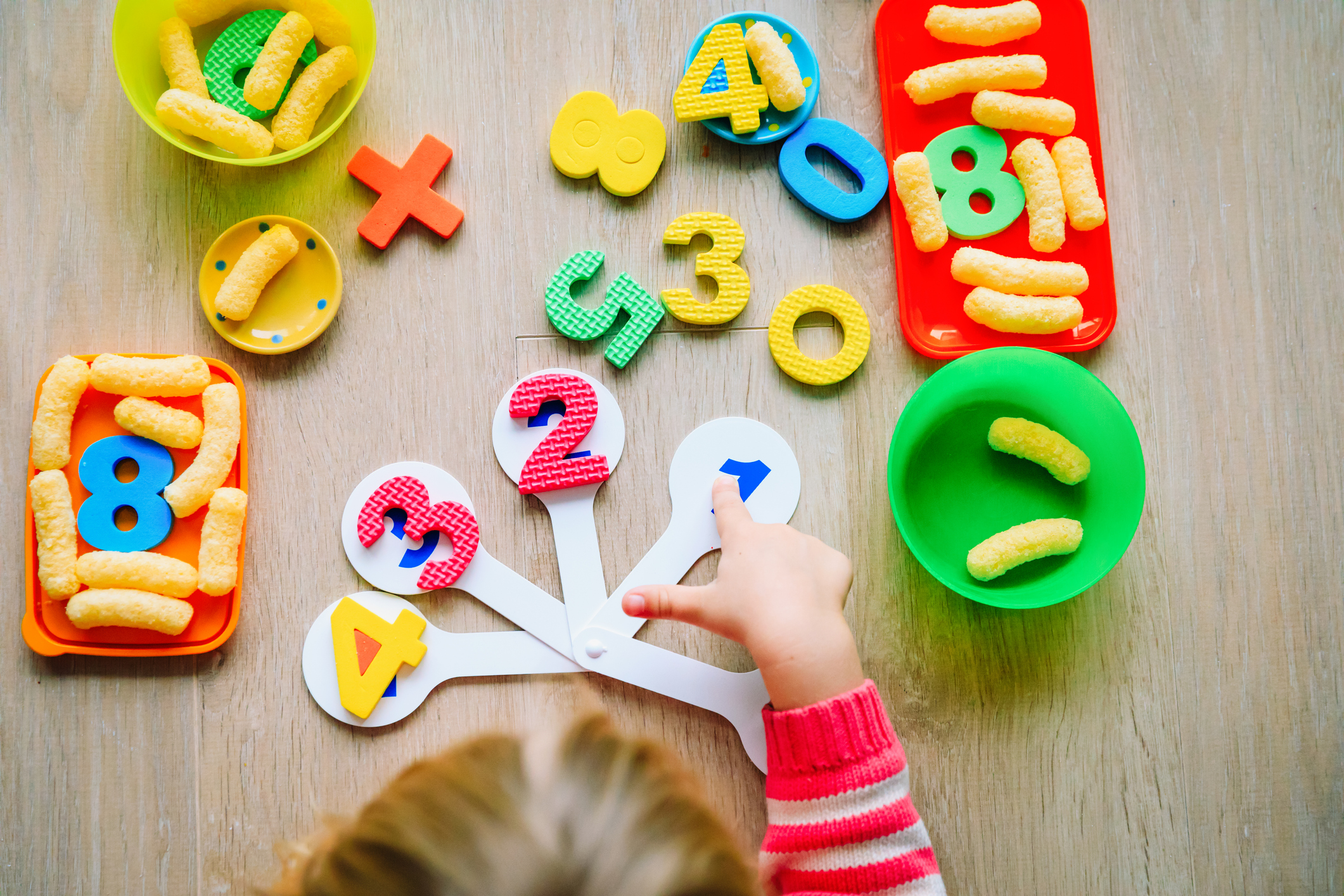
Elementary math is far broader than rote memorization and arithmetic. A complete curriculum spans number sense, geometry, measurement, data interpretation, and early algebraic thinking. However, the core of it all is number sense—a child's intuitive ability to understand what numbers mean and how they relate, rather than just how to manipulate them through standard algorithms.
Number sense means a child who sees seven apples doesn't count each one; they perceive "sevenness" as a whole quantity. It means understanding that splitting 6 into 3 and 3 is the same as splitting it into 4 and 2 using a part-part-whole model, and that these relationships are flexible.
In our practical experience at SunStart, children who develop strong conceptual foundations—rather than relying solely on procedural shortcuts—demonstrate more durable problem-solving capacity and long-term academic confidence.
2.How abstract mathematical concepts look in a child's daily life
Geometry is not just identifying a circle, square, triangle, hexagon, or octagon on a worksheet. When your child builds a tower and notices it keeps falling because the base is too narrow, they are exploring structural reasoning and spatial relationships. When they estimate whether a toy will fit in a box, they are actively applying measurement sense.
Modern instructional methods and Common Core frameworks increasingly reflect this shift. They move away from isolated skill drills toward integrated, context-rich learning where mathematical concepts appear in collaborative learning environments, physical building tasks, and real-life scenarios. For parents, this means the best support you can provide often looks nothing like traditional homework.
3. A developmental breakdown: Tracking math skills from Pre-K to 5th grade
Pre-K to Kindergarten: Establishing spatial reasoning and quantity awareness
At this stage, the primary goal is not recognizing numerals—it is establishing quantity awareness and spatial reasoning. A child who can tell you "this pile has more" without counting, or who can describe a shape's position as "inside," "beside," or "behind," is building the cognitive scaffolding for everything that follows in the math classroom.
The following table outlines observable behaviors that suggest solid development at each educational stage:
|
Grade Level |
Core Focus |
Observable Behavior |
|
Pre-K (ages 3–4) |
Quantity awareness, sorting |
Groups objects by color, size, or shape without prompting |
|
Kindergarten (ages 5–6) |
Number recognition, spatial language |
Counts reliably to 20, uses "more/less/equal" correctly |
|
1st Grade (ages 6–7) |
Addition/subtraction concepts |
Solves simple word problems using physical teaching tools |
|
2nd Grade (ages 7–8) |
Place value, early measurement |
Understands tens and ones; estimates lengths meaningfully |
|
3rd–5th Grade (ages 8–11) |
Multiplication, fractions, logic |
Explains reasoning, not just answers; applies math to real scenarios |
These developmental milestones provide a helpful roadmap for guiding your child's mathematical journey. Parents with children in the early years can explore Pre-Kindergarten math (ages 3–4) and Pre-Kindergarten math (ages 4–5) to see what a structured yet playful learning progression looks like.
1st to 2nd Grade: Transitioning from physical counting to early operations
The shift here involves moving from counting physical objects to understanding operations conceptually. A child who still needs to count every single finger to add 6 and 4 has not yet internalized number relationships. The goal is for addition and subtraction to feel logical—rooted in an understanding of "what happens when I combine or remove"—rather than functioning as memorized procedures.
If your first or second grader is struggling, returning to concrete manipulatives like coins, building blocks, or measuring cups provides excellent support. Physical experience with quantity makes abstract operations click in a way that written practice alone cannot replicate. Specialized programs designed for 1st grade math (ages 6–7) and 2nd grade math (ages 7–8) often build this bridge deliberately.
3rd to 5th Grade: Navigating abstract problem-solving and logic
By 3rd grade, children encounter fractions, multiplication, and multi-step word problems. This is often the point where families notice a child pulling back from math. This hesitation is rarely about intelligence; it usually indicates that foundational conceptual understanding was missed in earlier years.
At this stage, asking guiding questions rather than providing immediate answers is highly effective. Asking "What did you try first?" teaches children to monitor their own thinking—a vital skill called metacognition. Children who develop this habit become self-correcting, independent learners.
4. Rote memorization vs. interactive math learning: A framework for parents
Why standard worksheets often fail to build long-term retention
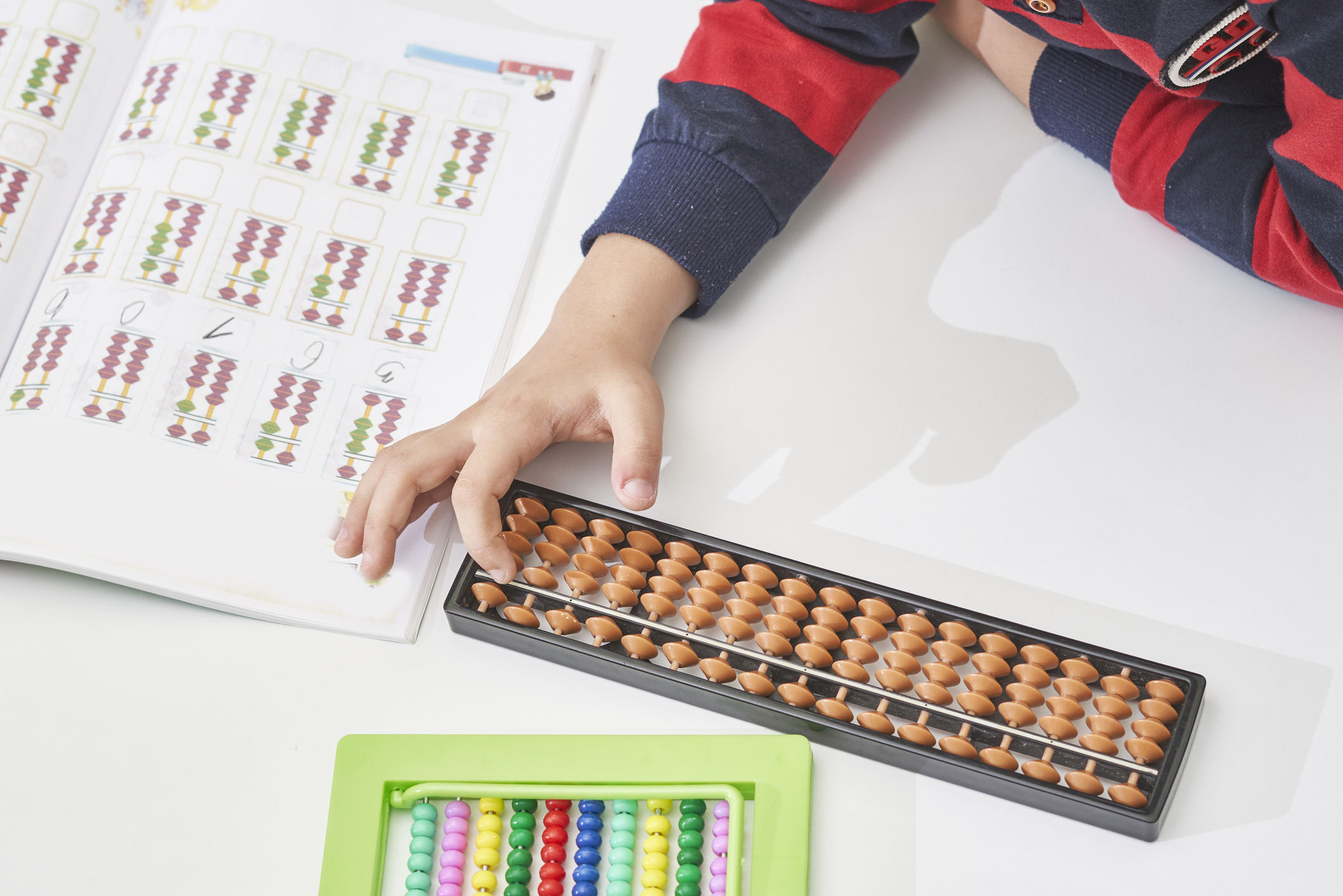
Standard worksheets certainly have their place, but they work best when a child already understands the underlying concept. Used too early, rote memorization trains children to pattern-match without true comprehension. A student who can complete 30 subtraction problems correctly on paper may still struggle to apply subtraction to figure out their change at a grocery store.
This distinction highlights two different educational goals: performance on isolated, predictable tasks versus the ability to transfer mathematical thinking to entirely new situations.
Fostering deep understanding through hands-on engagement
This table contrasts different instructional approaches directly:
|
Approach |
What it builds |
What it misses |
Best used for |
|
Rote memorization |
Speed on familiar problem types |
Transfer to new contexts |
Reinforcing facts already understood conceptually |
|
Interactive math learning |
Conceptual flexibility, reasoning |
May feel slower initially |
Building foundational understanding from scratch |
|
Hands-on exploration |
Spatial reasoning, experiential connection |
Less structured output |
Introducing abstract concepts concretely |
|
Guided reflection |
Metacognition, communication of thinking |
Requires adult facilitation |
Deepening student understanding after exploration |
By blending these instructional methods, parents and educators can create a more engaging and effective learning experience. Start with kinesthetic activities and hands-on exploration, move to guided reflection, and let memorization come last as a natural result of understanding.
5. Transforming homeschool routines: Using a dual-phase method to guide math discovery
Starting with digital courseware for independent exploration
Families who choose to homeschool often face the challenge of balancing a child's freedom to explore with enough structure to ensure progressive skill-building. A dual-phase approach effectively resolves this tension.
In the first phase, children explore independently without the pressure of immediately finding the correct answer. At SunStart, our Digital Courseware is designed precisely around this principle. Children navigate interactive stories, visual prompts, and game-based activities at their own pace. By providing real-time feedback and helpful learning hints, the multimedia resources guide them toward understanding while fostering genuine curiosity.
Bridging theory and practice with Hands-On Math Learning Through Play
The second phase introduces parental or expert guidance. After a child explores independently, the adult's role is to ask questions that help articulate the discovery. "What did you discover when you stacked those?" or "Why do you think that shape fit better?" These conversations turn raw play into structured logical thinking.
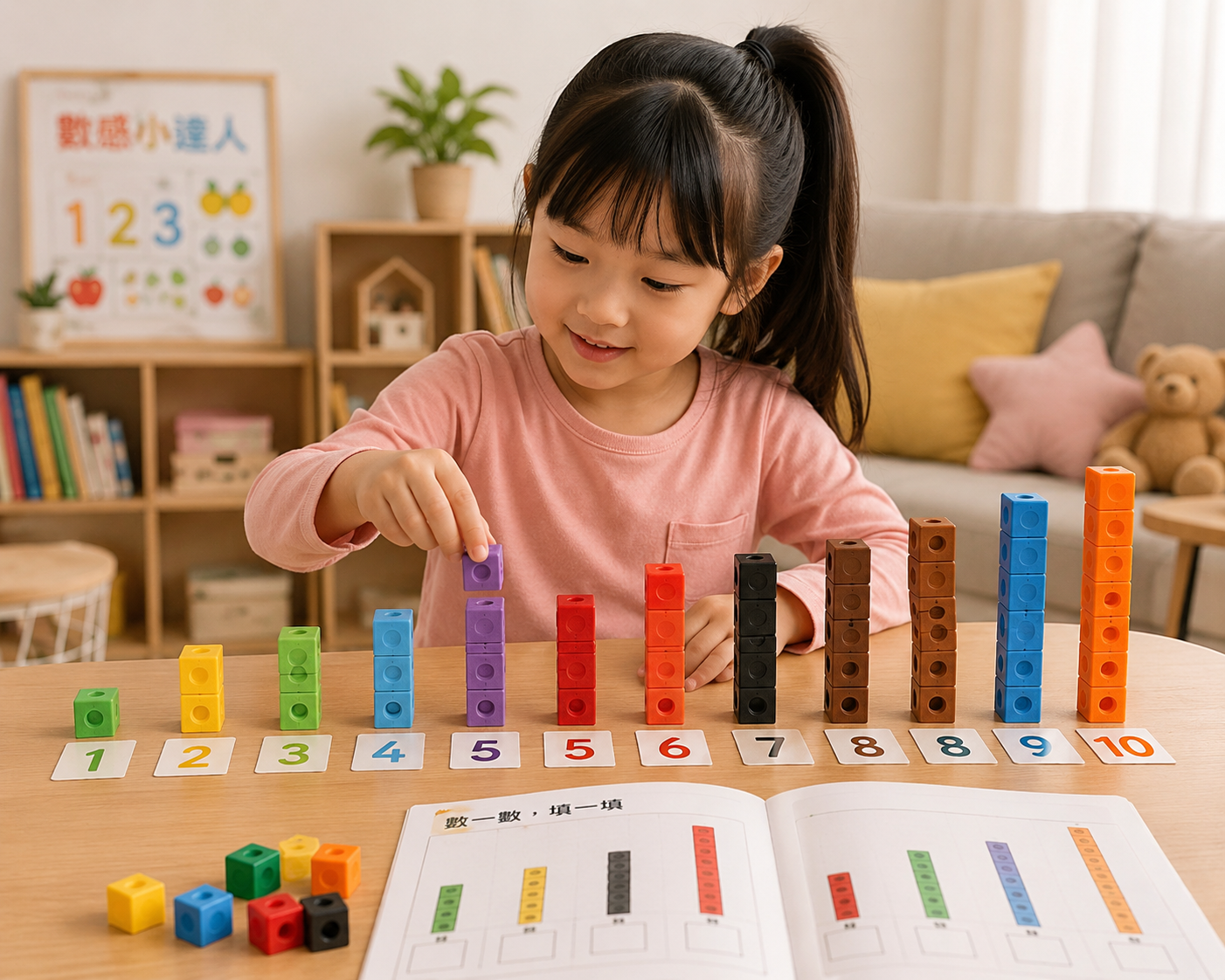
Our core teaching aids, such as the Logic and 2D & 3D shapes with Linking Cubes kit, give children a concrete reference point during this reflection phase. By holding a colorful cube, comparing its faces, and physically snapping it together, children reinforce spatial reasoning in ways that a screen or a flat workbook alone cannot replicate.
How reflection turns simple discovery into logical thinking
A child who builds a structure with Linking Cubes and then explains why they chose to put the larger, heavier pieces at the bottom is actively practicing sequential reasoning, hypothesis formation, and academic vocabulary. These are the exact problem-solving skills required for advanced elementary math. What looks like simple play on the surface is actually rigorous cognitive development.
6. Addressing common concerns: How to help children overcome elementary math anxiety
What causes a child to feel overwhelmed by numbers?
Math anxiety rarely begins with the math itself. It usually stems from a specific moment of perceived failure—being called out for a wrong answer, feeling paralyzed by a timed assessment, or being compared to peers. The child begins to associate math with judgment, leading to avoidance.
Recognizing this root cause helps parents respond more compassionately. Your goal is not to force the child to admit math is easy. Instead, aim to gradually rebuild a sense of safety and confidence around mathematical thinking.
Adjusting your support when children learn at a different pace
Every child has a unique readiness window. A student who is not yet ready to compute written fractions may perfectly understand how to divide a real pizza into equal parts and explain why everyone gets a fair share. Meeting children at their concrete level of understanding—rather than rushing toward symbolic representation—is the single most effective adjustment you can make.
For children who need more time to grasp numeracy concepts, shift the emphasis from finding the exact answer to exploring the process. Praise their effort, their creative questions, and their willingness to try multiple methods.
Shifting the focus from correct answers to the thinking process
Consider your immediate reaction when your child gets an answer wrong. If the default response is instant correction, the child learns to prioritize being "right" over thinking carefully. If your response is curious—"That's an interesting approach, how did you get there?"—the child learns that thinking out loud is safe.
If you encounter persistent distress around math, please feel free to reach out. We are always happy to discuss what age-appropriate, positive support looks like for your child's specific learning style.
7. Observe how joyful problem-solving looks in your own living room
The most important takeaway is a shift in perspective: elementary math is not merely a subject bound to a classroom. It is a fundamental way of thinking that your child already practices every single day—in the block towers they design, the snacks they divide, and the spatial routes they navigate.
Your role at home is to act as a curious companion rather than a strict instructor. Ask more questions than you answer. Create ample space for trial and error. Celebrate the moment your child says, "Wait, let me try it a different way," because that flexibility is the true goal of education.
If you would like to see what this kind of thinking-focused, interactive learning looks like in a structured environment, we invite you to explore our resources. Watching how a child engages when the process is valued more than the final answer will tell you everything you need to know about their potential.
8. Frequently Asked Questions
What kind of math is taught in elementary school, and what does it include?
Modern elementary math covers far more than basic addition and subtraction. From Pre-K through 5th grade, the curriculum includes number sense, basic operations, geometry (understanding 2D and 3D shapes), measurement, data interpretation, and early algebraic thinking. It is heavily focused on spatial reasoning, pattern recognition, and logical problem-solving.
Is the order of operations called PEMDAS or BODMAS?
Parents often wonder which acronym is correct. In the U.S., PEMDAS (Parentheses, Exponents, Multiplication/Division, Addition/Subtraction) is the standard mnemonic introduced in upper elementary and middle school. In other parts of the world, such as the UK, BODMAS (Brackets, Orders, Division/Multiplication, Addition/Subtraction) is used. Both represent the exact same mathematical rules.
How do you say "I love you" in math to make learning fun?
Building confidence often involves making the learning experience playful. You can show your child how to say "I love you" in math by writing 128√e980 on a piece of paper and covering the top half, or by exploring how to graph the equation of a heart. Fun tricks like these spark curiosity and show kids that math can be creative.
My child seems to hate math already. Is it too late to change that?
It is never too late. Math anxiety is almost always rooted in a stressful experience or association, not a lack of innate ability. Returning to low-pressure, concrete exploration with physical teaching tools free from timed tasks or performance expectations—can gradually rebuild their confidence and engagement.
How much time should we spend on math at home each day?
For most elementary-age children, 15 to 20 minutes of highly engaged, interactive math activity is far more effective than an hour of distracted, repetitive practice. Short, positive sessions that end while the child is still curious are substantially better for long-term retention than long sessions that end in frustration.
Can hands-on learning really replace traditional math practice?
Hands-on learning is a powerful foundation, not necessarily a permanent replacement for all written work. Once a child understands a concept concretely through physical play and manipulation, written practice becomes much more meaningful because they can visualize the math. The proper sequence is vital: concrete experience first, abstract practice second.