




- Sep 10, 2026
- Featured Insights
Critical Thinking Activities for Kids: 15 Fun Ways to Build Problem-Solving Skills at Home
Children ask questions all the time.
Why is the sky blue?
Why does ice melt faster in one cup than another?
Why do blocks fall down when the tower gets too tall?
To adults, these questions can feel random or even exhausting. But for children, they are the beginning of critical thinking. Every “why,” “how,” and “what if” is a chance to help kids observe, reason, test ideas, and explain what they think.
In this guide, you’ll find 15 age-appropriate critical thinking activities for kids ages 3–12. These activities include sorting games, logic puzzles, building challenges, board games, role-play questions, mini-debates, and parent prompts you can use at home.
The goal is not to make children “think like adults.” The goal is to help them build the habit of thinking before answering, trying more than one solution, and learning from mistakes without fear.
What Is Critical Thinking for Kids?
Critical thinking is the ability to look at a situation, ask meaningful questions, consider different possibilities, and make a reasoned choice.
For children, critical thinking does not need to look academic or serious. It often appears during play, conversation, and everyday problem-solving.
A child is practicing critical thinking when they:
- Try a new way to build a block tower after it falls
- Guess what might happen next in a story
- Explain why one puzzle piece does not fit
- Compare two possible solutions before choosing one
- Change their strategy after something does not work
- Ask “why” or “how” instead of simply accepting an answer
At SunStart , we believe that thinking skills can be developed through practice. When children explore different solutions through open-ended questions, hands-on activities, and experiential learning, they discover that making mistakes is simply part of the learning and thinking process.
Why Critical Thinking Activities Matter for Children
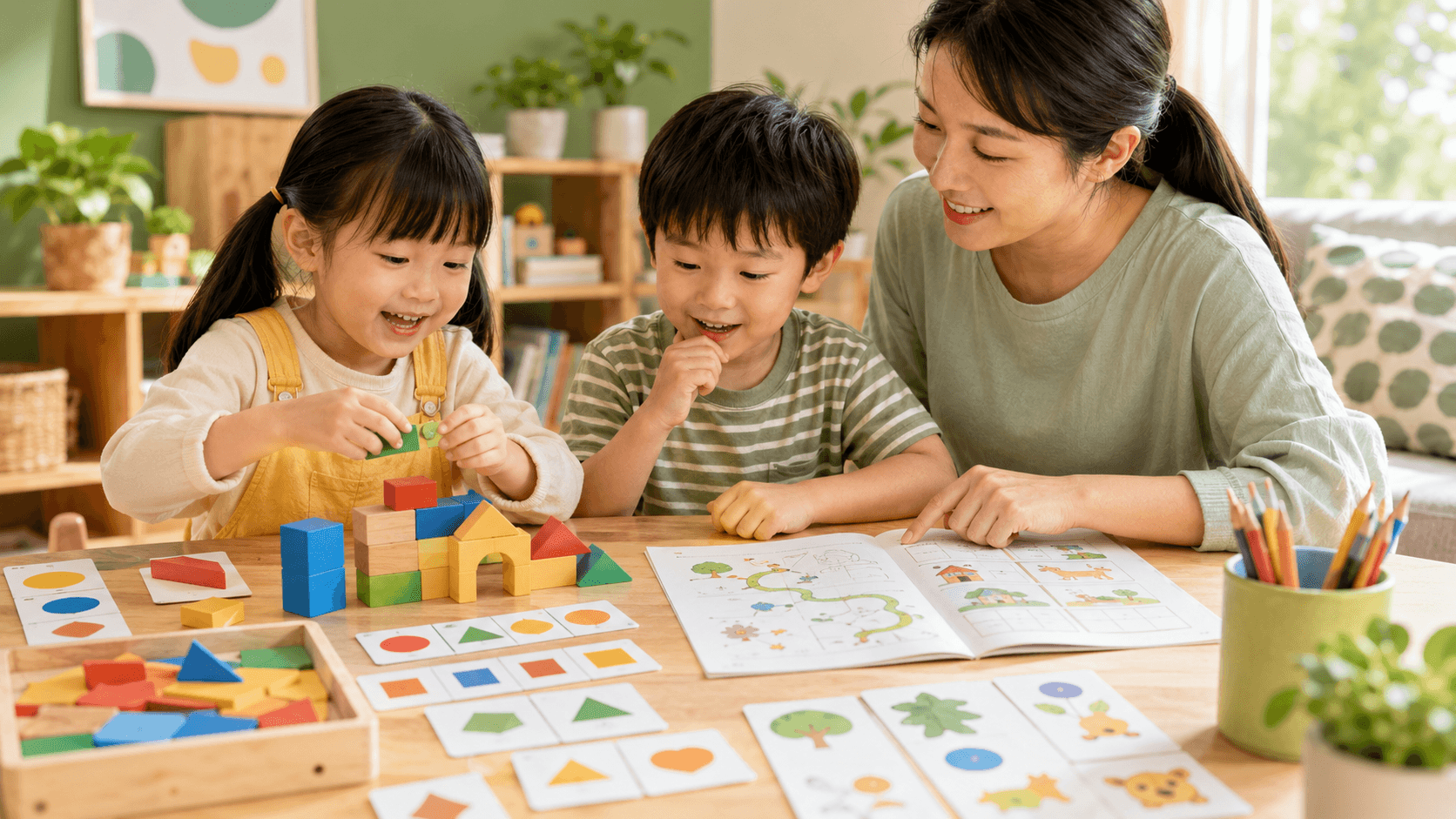
Children are naturally curious, but curiosity needs the right environment to grow.
If adults always give the answer too quickly, children may learn to wait for instructions. But when adults ask, “What do you think?” or “How could we test that?” children begin to see uncertainty as something they can explore.
That's why many educators create problem solving activities for kids. As children observe, make predictions, test their ideas, and adjust their strategies, they aren't simply completing a task—they're developing the mindset needed to tackle new challenges with confidence.
Critical thinking activities help children develop:
- Problem-solving skills
- Logical reasoning
- Observation skills
- Communication skills
- Patience and focus
- Confidence when facing unfamiliar problems
- The ability to explain their thinking
Parents don't need special equipment or a formal classroom to nurture these skills. A dining table, a few toys, a storybook, or even a short conversation can become an opportunity for experiential learning. Any activity that encourages children to explore, try different approaches, and solve problems can become a meaningful problem solving activity for kids, helping them naturally develop critical thinking skills in everyday life.
Quick List: 15 Critical Thinking Activities for Kids
Here are 15 simple activities that can help children build critical thinking and problem-solving skills at home:
- Sorting by two rules
- Build-a-bridge challenge
- Pattern worksheets
- Mystery object guessing
- Cause-and-effect play
- Memory prediction games
- Simple logic grids
- Role-play problem cards
- Board games
- Story prediction questions
- Sudoku and logic puzzles
- Mini-debates
- Budget planning challenge
- Compare-and-explain games
- Multi-step problem-solving projects
Each activity can be adjusted based on your child’s age, attention span, and confidence level. The most important part is not whether your child gets the answer right immediately. It is whether they are learning to observe, question, think, and explain.
Critical Thinking Activities by Age and Skill
Use this table as a quick guide to choose the right activity for your child’s age and current thinking level.
| Age Range | Activity | Thinking Skill It Builds | What Parents Can Watch For |
| Ages 3–5 | Sorting by two rules | Classification and early logic | Child explains why an object belongs in a group |
| Ages 3–5 | Build-a-bridge challenge | Cause and effect, trial and error | Child changes the design after the bridge falls |
| Ages 3–5 | Pattern worksheets | Pattern recognition and prediction | Child notices what comes next in a sequence |
| Ages 3–5 | Mystery object guessing | Observation and evidence-based guessing | Child uses clues before naming the object |
| Ages 3–5 | Cause-and-effect play | Prediction and testing | Child compares what they expected with what happened |
| Ages 6–8 | Memory prediction games | Recall and logical prediction | Child makes choices based on previous turns |
| Ages 6–8 | Simple logic grids | Deductive reasoning | Child eliminates options using clues |
| Ages 6–8 | Role-play problem cards | Social reasoning and decision-making | Child names more than one possible solution |
| Ages 6–8 | Board games | Planning and flexible thinking | Child thinks ahead before making a move |
| Ages 6–8 | Story prediction questions | Reading comprehension and inference | Child uses story clues to explain a prediction |
| Ages 9–12 | Sudoku and logic puzzles | Systematic reasoning | Child checks rules before writing an answer |
| Ages 9–12 | Mini-debates | Perspective-taking and communication | Child can explain both sides of an issue |
| Ages 9–12 | Budget planning challenge | Trade-off thinking and planning | Child adjusts the plan when limits appear |
| Ages 9–12 | Compare-and-explain games | Reasoning and evaluation | Child gives reasons instead of only stating a preference |
| Ages 9–12 | Multi-step projects | Planning, testing, and revising | Child monitors progress and changes strategy |
Critical Thinking Activities for Preschoolers Ages 3–5
Preschoolers learn best through hands-on play. At this age, children need to touch, move, sort, build, and experiment with real objects.
For ages 3–5, the best critical thinking activities are simple, visual, and concrete.
Activity 1: Sorting by Two Rules
Best for: Ages 3–5
What you need: Blocks, buttons, toy animals, colored paper, or household objects
Ask your child to sort objects by one rule first, such as color. Then ask them to sort by a second rule, such as size or shape. For example, they may need to find all the small red blocks or all the big blue circles.
This activity helps children practice classification, attention, and early logical thinking. Holding two rules in mind at the same time is an important foundation for later math reasoning.
Parent prompt:
“How did you decide where this one belongs?”
Watch for:
Your child begins to explain the rule instead of only moving objects randomly.
Activity 2: Build-a-Bridge Problem-Solving Activity
Best for: Ages 3–5
What you need: Blocks, paper cups, cardboard, toy cars, or small toys
Invite your child to build a bridge that can hold a toy car or small object. If the bridge falls, avoid fixing it immediately. Instead, ask them to observe what happened.
This activity helps children learn cause and effect. They begin to notice that some structures are stronger than others and that changing the base, height, or balance can lead to different results.
Parent prompt:
“What part do you think fell first?”
Watch for:
Your child tries a new design after the first one does not work.
Activity 3: Pattern Worksheets
Best for: Ages 3–5
What you need: Printable pattern worksheets, stickers, blocks, or colored objects
Give your child a simple pattern, such as red-blue-red-blue, and ask them what comes next. You can also use shapes, animals, or movements.
Pattern activities support early math skills and logical prediction. When children identify what comes next, they are learning to observe structure and make a reasoned guess.
Parent prompt:
“What do you notice about the order?”
Watch for:
Your child explains the pattern instead of only guessing the next item.
Activity 4: Mystery Object Guessing
Best for: Ages 3–5
What you need: A bag and several familiar objects
Place an object inside a bag and let your child feel it without looking. Ask them to describe what they notice: Is it soft? Hard? Round? Heavy? Smooth?
This activity helps children slow down and use evidence before making a guess. It also builds vocabulary and observation skills.
Parent prompt:
“What clues helped you make that guess?”
Watch for:
Your child uses descriptive clues rather than naming the object immediately.
Activity 5: Cause-and-Effect Play
Best for: Ages 3–5
What you need: Ice cubes, water, cups, toy cars, ramps, or simple household items
Set up a small experiment. For example, place ice cubes in two different cups and ask your child which one they think will melt faster. Or roll a toy car down ramps of different heights.
This activity introduces children to prediction and testing. They learn that they can make a guess, observe the result, and compare what actually happened.
Parent prompt:
“What do you think will happen? Why?”
Watch for:
Your child compares the result with their original prediction.
Critical Thinking Activities for Kids Ages 6–8
Children ages 6–8 are ready for more structured problem-solving. They can usually follow simple rules, remember clues, and explain their thinking with more detail.
At this stage, the best activities involve logic, prediction, and decision-making.
Activity 6: Memory Prediction Games
Best for: Ages 6–8
What you need: A memory card game or matching cards
Play a memory game, but encourage your child to explain their choices before flipping a card. Instead of choosing randomly, they can use what they remember from previous turns.
This activity helps children practice observation, memory, and prediction. They learn that past information can guide future decisions.
Parent prompt:
“Why do you think that card might be there?”
Watch for:
Your child starts making choices based on previous observations.
Activity 7: Simple Logic Grids
Best for: Ages 6–8
What you need: A simple logic puzzle or homemade clue chart
Create a basic puzzle with three children, three favorite fruits, and three clues. For example: “Mia does not like apples. Ben likes bananas. Sara does not like oranges.”
Children use the clues to eliminate options and find the answer. This teaches them that ruling something out is part of problem-solving.
Parent prompt:
“What do we know for sure? What can we cross out?”
Watch for:
Your child uses clues instead of guessing randomly.
Activity 8: Role-Play Problem-Solving Cards
Best for: Ages 6–8
What you need: Index cards or small pieces of paper
Write simple situations on cards, such as:
“You find a wallet on the playground.”
“Your friend wants to play a game you do not like.”
“You forgot your homework at home.”
Ask your child what they could do and what might happen next.
This activity helps children think through choices, consequences, and other people’s perspectives. It builds both reasoning and social problem-solving skills.
Parent prompt:
“What are two different choices you could make?”
Watch for:
Your child names more than one possible solution.
Activity 9: Board Games
Best for: Ages 6–8
What you need: Age-appropriate board games, strategy games, or simple chess-style games
Board games help children practice planning, turn-taking, and flexible thinking. The key is not only playing the game, but talking about the thinking behind each move.
You can model your own reasoning by saying things like, “I’m choosing this move because I think it gives me more options next turn.”
Parent prompt:
“What do you think might happen if you choose that move?”
Watch for:
Your child begins to plan ahead instead of only reacting to the current turn.
Activity 10: Story Prediction Questions
Best for: Ages 6–8
What you need: A storybook or short reading passage
Pause during a story and ask your child what they think will happen next. Then ask why. After reading more, compare their prediction with what actually happened.
This activity helps children use evidence from the story to form ideas. It also strengthens reading comprehension and verbal reasoning.
Parent prompt:
“What clues in the story made you think that?”
Watch for:
Your child refers to story details when explaining their prediction.
Critical Thinking Activities for Kids Ages 9–12
Children ages 9–12 can handle more complex reasoning. They are often ready for multi-step problems, abstract thinking, structured debate, and planning challenges.
At this age, the goal is to help children explain their thinking more clearly and consider more than one point of view.
Activity 11: Sudoku and Logic Puzzles
Best for: Ages 9–12
What you need: Sudoku puzzles, logic puzzles, or number-placement games
Sudoku and similar puzzles require children to narrow down possibilities based on existing information. They must check whether each answer fits the rules.
This activity builds patience, attention to detail, and systematic thinking.
Parent prompt:
“How do you know this number belongs here?”
Watch for:
Your child checks the rules before writing an answer.
Activity 12: Mini-Debates
Best for: Ages 9–12
What you need: A simple topic and a few minutes of conversation
Choose a child-friendly topic, such as:
“Should kids have homework every day?”
“Should everyone help with chores at home?”
“Is it better to read books or watch videos to learn?”
Ask your child to explain one side. Then ask them to try arguing the opposite side.
This activity helps children practice reasoning, communication, and perspective-taking. It also teaches them that a strong thinker can understand more than one viewpoint.
Parent prompt:
“What would someone who disagrees with you say?”
Watch for:
Your child can explain both sides of an issue.
Activity 13: Budget Planning Problem-Solving Challenge
Best for: Ages 9–12
What you need: Paper, pencil, and a pretend budget
Give your child a simple planning challenge. For example, ask them to plan a birthday party with a limited budget or design a one-day family trip with a set amount of money.
They need to compare options, make trade-offs, and explain their decisions.
This activity builds executive function, decision-making, and real-world problem-solving skills.
Parent prompt:
“If you spend more here, what will you need to spend less on?”
Watch for:
Your child adjusts the plan when the first version does not work.
Activity 14: Compare-and-Explain Games
Best for: Ages 9–12
What you need: Two objects, two solutions, two stories, or two options to compare
Give your child two choices and ask them to compare. For example:
“Which bridge design is stronger?”
“Which character made the better decision?”
“Which solution would be fairer?”
The goal is not just choosing one. The goal is explaining the reason behind the choice.
Parent prompt:
“What makes this option better? Is there any situation where the other option would work?”
Watch for:
Your child gives reasons instead of only stating a preference.
Activity 15: Multi-Step Problem-Solving Activities
Best for: Ages 9–12
What you need: A small project, notebook, or planning sheet
Ask your child to solve a problem over several steps. For example:
Design a better homework routine.
Plan how to organize a messy shelf.
Create a simple board game with rules.
Build a model using limited materials.
Multi-step projects teach children to plan, test, revise, and finish. These are important skills for both academic learning and everyday independence.
Parent prompt:
“What is your first step? How will you know if your plan is working?”
Watch for:
Your child monitors progress and makes changes along the way.
Parent Prompts That Build Critical Thinking

The way adults respond during activities matters as much as the activity itself.
Many parents naturally want to help by giving the answer. But when adults answer too quickly, children may miss the chance to think through the problem.
A better approach is to ask questions that keep the thinking process open.
Instead of saying, “That’s wrong,” try asking:
“What made you choose that answer?”
Instead of saying, “Try turning it around,” try asking:
“Which part does not seem to fit?”
Instead of saying, “The answer is this,” try asking:
“What do you already know that might help?”
Instead of saying, “Good job, you’re done,” try asking:
“How do you know your answer works?”
Instead of saying, “Stop arguing and share,” try asking:
“What does each person want? Is there a solution that works for both of you?”
These small changes help children develop the habit of self-questioning. Over time, they may begin asking themselves the same kinds of questions when solving problems independently.
Parent Prompts That Encourage Critical Thinking
The words adults use during an activity can either close the thinking process or help children go deeper. Use this table to turn common responses into critical thinking prompts.
| Everyday Situation | Common Adult Response | Critical Thinking Prompt |
| Child cannot solve a puzzle | “Try turning it around.” | “Which part does not seem to fit? What does that tell you?” |
| Child asks why something happened | “That’s just how it works.” | “What do you think caused it? How could we test that?” |
| Child gives up on a hard task | “It’s okay, it’s too hard.” | “What is one part you have already figured out?” |
| Child makes a mistake | “That’s wrong. Try again.” | “That did not work the way you expected. What could you try next?” |
| Child asks for the answer | “The answer is this.” | “What are two things you already know that might help?” |
| Child finishes too quickly | “Good job, you’re done.” | “How do you know your answer works? Could another answer work too?” |
| Child argues with a sibling | “Stop arguing and share.” | “What does each person want? Is there a solution that works for both?” |
| Child guesses randomly | “Don’t guess.” | “What clue can help you make a better guess?” |
| Child chooses one option | “Okay, do that one.” | “Why did you choose this option instead of the other one?” |
| Child feels frustrated | “Calm down.” | “Which part feels confusing right now?” |
Common Mistakes Parents Make When Teaching Problem-Solving
Helping children think critically does not mean making every activity difficult. It also does not mean turning playtime into a test.
Here are a few common mistakes to avoid.
Mistake 1: Giving the Answer Too Quickly
It can be hard to watch a child struggle, especially when the solution seems obvious. But a little struggle can be useful.
If your child is stuck, try giving a small clue instead of the answer. Ask what they have already tried or what they notice about the problem.
The goal is to support the thinking process without taking it over.
Mistake 2: Praising Only the Correct Answer
When adults only praise the right answer, children may start to believe that being correct matters more than thinking carefully.
Instead, praise the process.
You can say:
“I like how you tried a different strategy.”
“You noticed an important clue.”
“You changed your plan when the first idea did not work.”
This helps children value effort, reasoning, and flexibility.
Mistake 3: Making the Activity Too Advanced
A challenge should feel interesting, not impossible.
If an activity causes too much frustration, simplify it. Use fewer objects, fewer clues, or a shorter task. Once your child gains confidence, you can slowly increase the difficulty.
Critical thinking grows best through steady practice, not pressure.
Mistake 4: Turning Every Question Into a Lesson
Not every child’s question needs a long explanation. Sometimes the best response is short and curious.
When your child asks, “Why did that happen?” you can simply say:
“What do you think?”
This keeps the conversation open and gives your child space to think.
How SunStart Helps Children Build Thinking Skills Step by Step
At SunStart, our learning philosophy is built around one core idea: children learn best when they actively think, explore, and explain.
We use math as a pathway to build broader thinking skills. Through hands-on materials, guided activities, visual models, and structured practice, children learn to observe patterns, compare options, test ideas, and express their reasoning.
Our curriculum follows a spiral learning approach. This means children revisit important thinking skills again and again at deeper levels.
For example, a preschooler may begin by sorting objects by color and size. Later, that same child may use similar reasoning to understand patterns, relationships, and early algebraic thinking.
The skill grows over time.
This is why we focus not only on getting the correct answer, but also on helping children understand how they reached that answer.
A child who knows how to think can face new problems with confidence. A child who only memorizes answers may feel stuck when a problem looks unfamiliar.
How Often Should Kids Practice Critical Thinking Activities?
Short and consistent practice is more effective than long, occasional sessions.
For most children, 10 to 15 minutes of thinking activities a few times per week is enough to build momentum. Parents can also include small thinking prompts during everyday routines.
For example:
During dinner:
“What was one problem you solved today?”
During reading time:
“What do you think will happen next?”
During playtime:
“What could you try differently?”
During cleanup:
“What is the fastest way to organize these toys?”
Critical thinking does not need to be a separate subject. It can become part of how a family talks, plays, reads, and solves problems together.
Frequently Asked Questions About Critical Thinking Activities for Kids
What are the best critical thinking activities for kids?
The best critical thinking activities for kids are activities that encourage children to observe, ask questions, test ideas, and explain their reasoning. Sorting games, building challenges, board games, logic puzzles, role-play scenarios, story prediction questions, and mini-debates are all strong options.
How do you teach critical thinking to a child?
You can teach critical thinking by asking open-ended questions, giving children time to solve problems, and encouraging them to explain their thinking. Instead of giving the answer right away, ask questions like “What do you notice?” “What else could work?” or “How do you know?”
At what age should kids start problem-solving activities?
Children can begin simple problem-solving activities around ages 2 or 3 through sorting, building, matching, and cause-and-effect play. More structured logic activities, puzzles, and reasoning games usually become more effective around ages 5 or 6.
What games improve critical thinking skills?
Games that involve planning, memory, logic, strategy, or comparison can improve critical thinking skills. Examples include memory games, puzzles, Sudoku, chess-style games, board games, logic grids, and building challenges.
What is the difference between critical thinking and problem-solving?
Problem-solving is about finding a solution to a specific problem. Critical thinking is the broader skill of asking questions, evaluating information, comparing possibilities, and making reasoned decisions. Good problem-solving usually requires critical thinking.
Can preschoolers learn critical thinking?
Yes. Preschoolers can practice early critical thinking through hands-on activities such as sorting, building, matching, predicting, and simple experiments. At this age, the goal is not formal logic. The goal is helping children notice patterns, test ideas, and explain what they see.
What should I do if my child gives up easily?
If your child gives up easily, make the first step smaller. Ask, “What is one thing you already know?” or “Which part can we try first?” This helps your child feel capable of starting, instead of feeling overwhelmed by the whole problem.
Start Building Critical Thinking Through Everyday Play
Critical thinking doesn't have to be developed through rigid exercises. Whether at home, in the classroom, or during playtime, age-appropriate problem solving activities for kids and experiential learning can turn everyday challenges into meaningful opportunities to develop critical thinking skills.
At SunStart, our 2D & 3D Shapes Learning Kit is designed to support children's developmental stages by encouraging them to explore shapes, sort, build, and develop spatial awareness. Through experiential learning, children naturally strengthen their observation, reasoning, and problem-solving skills. Rather than simply learning geometry concepts, they build critical thinking skills through every exploration, discovery, and hands-on experience.
Learn more: 2D & 3D Shapes Learning Kit