



- Nov 17, 2026
- Learning Topics
12 Number Sense Games for Kids: Dice, Cards, and Movement
Number sense games help children connect number words to real quantities, compare amounts, and try different ways to make a total. These 12 games use dice, cards, homemade boards, and movement. Each includes simple rules, an age range, and a variation. Choose a game that feels achievable, then invite your child to explain how they know their answer. Suggested ages are flexible, and adults should supervise play with small objects.
For an explanation of the underlying concepts, read SunStart's Number Sense: The First Step Toward Mathematical Thinking.
Choose an Activity
Choose a playful challenge that fits your child. Each activity below includes a visual example and a simple way to explore the idea together.
| 01 Race to 20 | 02 Dice Flash | 03 Paper Shut the Box |
| 04 Flip and Order | 05 One More, One Less | 06 Tens Go Fish |
| 07 Cereal Box Number Path | 08 Bump! | 09 Hundred-Chart Treasure Hunt |
| 10 Jump the Roll | 11 Bucket Toss Addition | 12 Treasure Grab Relay |
What Games Add to Number Practice
Games give counting and comparing a purpose. A child may need to recognize a small quantity, predict a total, or decide which move to make next. The Erikson Institute Early Math Collaborative describes number sense as understanding quantities, not simply reciting number words. Play can provide useful opportunities for that understanding to grow.
In Start Math teaching sessions, educators have encountered children who can recite numbers confidently but still need support matching one count to one object. Slowing down a dice game and moving one piece for each spoken number gives the child a concrete way to check a count.
Give children time to count, compare, and check their ideas. Keep the game enjoyable and stop or simplify it if the rules become frustrating. Use large child-safe counters; avoid loose beans, buttons, or coins with children who may put objects in their mouths.
Dice Games
1. Race to 20
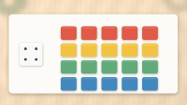
For 2-4 players, use one large die and at least 40 large, age-appropriate counters or linking cubes. On each turn, roll the die and collect that many counters. Arrange your collection in groups of five so you can see your progress. The first player to reach exactly 20 wins; if a roll would take a player above 20, that player waits until the next turn. For beginners, the first player to reach or pass 20 wins.
To change the challenge, play "Race to Zero" — start with 20 counters and give them back each roll, for early subtraction. This game practices counting on and the structure of fives and tens. Suggested ages: 4-7.
2. Dice Flash

For 2 players, use one die and an opaque cup. One player shakes the die under the cup, lifts the cup for just two seconds, and covers it again. The other player calls out the number without counting the dots. Score a point per correct flash, swap roles after five turns, and play to 10.
To change the challenge, use two dice and call out the total; or flash dominoes instead of dice. This game practices recognizing small quantities without counting each dot one at a time (subitizing). Suggested ages: about 3-6.
3. Paper Shut the Box
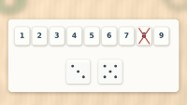
For 1-2 players, use two dice, a pencil, and a paper strip showing the numbers 1-9 in a row. Roll both dice and add them. Cross off any numbers that add up to your total — for a roll of 8, cross off the 8, or 5 and 3. Keep rolling until you can't cross anything off, then add up what's left: that's your score. Lowest score wins, and crossing off every number is "shutting the box."
To change the challenge, for beginners, use one die and numbers 1-6, crossing off exactly the number rolled. This game practices decomposing numbers — the part-whole thinking behind addition fluency. Suggested ages: 6-8.
Card Games (One Deck, Three Games)
Use a standard deck with face cards and 10s removed; an ace counts as 1. Keep all playing cards away from children who mouth or tear small pieces.
4. Flip and Order
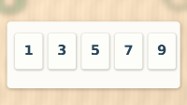
For 2-4 players, use one deck, cards 1-9 only. Deal each player five cards face down in a row. On "go," everyone flips their cards and races to rearrange them from smallest to largest. The first to finish calls "done," and the group checks the line together. A correct line earns a point; first to five points wins.
To change the challenge, order largest to smallest, or deal seven cards. This game practices number order and magnitude. Suggested ages: 4-6.
5. One More, One Less
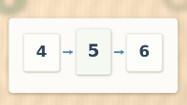
For 2-4 players, use cards 1-9 in a face-down pile. Turn over one card. On the first round, players say the number that is one more; on the next round, one less. Alternate the rule each round. The first correct answer earns the card. When the pile is empty, count cards to see who collected the most. Check special cases: one less than 1 is 0, and one more than 9 is 10.
To change the challenge, for ages 7-8, play "ten more, ten less" using two flipped cards as a two-digit number. This game practices fluent movement along the number sequence without recounting from 1. Suggested ages: 4-6.
6. Tens Go Fish
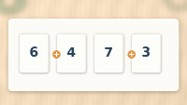
For 2-4 players, use one deck, cards 1-9 only. Deal five cards to each player and put the rest face down as a draw pile. On your turn, choose a card in your hand and ask another player for the number that makes 10 with it: holding 6, ask for 4. If they have it, take one matching card and lay down the pair; otherwise draw a card. Refill hands from the draw pile as needed. Continue until no more pairs can be made; the player with the most pairs wins.
To change the challenge, play "Fives Go Fish" with cards 1-4 for younger children. This game practices recognizing number pairs that total ten and explaining part-whole relationships. Suggested ages: about 6-8.
DIY Board Games (One Cereal Box, Big Payoff)
Building a board together also gives children a reason to count and write numerals. Start with a short path for younger players and expand it when they are ready.
7. Cereal Box Number Path
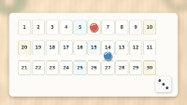
For 2-4 players, use a flattened cereal box, a marker, one die, and large counters or linking cubes as player tokens. Draw a path of 30 squares, numbered 1-30. Mark three bonus squares (move forward 2) and three setback squares (move back 2). On each turn, roll and move while counting from the current square. The first player to reach or pass 30 wins; do not move below square 1.
To change the challenge, landing on a number ending in 0 earns an extra turn — a quiet spotlight on the tens. This game practices number order to 30, counting on from any number, and numeral recognition. Suggested ages: 4-7.
8. Bump!
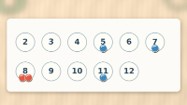
For 2 players, use a paper game board marked 2-12, two dice, and eight counters per player in two colors. Roll two dice, add their dots, and place one of your counters on that number. If your opponent has one loose counter there, return it to them. If you already have one counter there, add a second and lock that space; locked spaces cannot be bumped. If every matching space is locked, skip the turn. The first player to place all their counters wins; if neither player can make a legal move, the player with more locked spaces wins.
To change the challenge, use one die and a 1-6 board for pre-addition players. This game practices addition facts to 12, plus an intuitive feel for which sums come up often. Suggested ages: 6-8.
9. Hundred-Chart Treasure Hunt
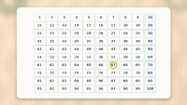
For 2 players, use a printed hundred chart, one die, a token for each player, and a treasure marker. Place the treasure between 50 and 80 on a hundred chart. Both players start at 1. Roll one die; choose to add either the rolled number or ten times that number to your position, staying at or below 100. Say the calculation aloud (for example, 34 + 20 = 54). The first player to reach or pass the treasure number wins. Use the chart to track the moves.
To change the challenge, older players can move backward by ones or tens, or try to land exactly on the treasure number. This game practices place value — tens and ones as two different kinds of moves. Suggested ages: 7-8.
Big-Movement Games (Burn Energy, Build Numbers)
Movement can make quantities visible: children perform a number of actions, stop, and check whether the count matches the target. Offer seated or gentle options and keep the space clear.
10. Jump the Roll
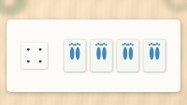
For 1-4 players, use one large foam die and clear floor space. Roll the die, read it, and do that many of the called movement — frog jumps, claps, stomps, or twirls. Everyone counts aloud together as the player moves, stopping exactly on the target number. Rotate who rolls and who picks the movement; no winner needed at this age.
To change the challenge, roll twice and do the two movements back to back — "3 jumps and 2 claps" — for early combining. This game practices one-to-one correspondence anchored in the body, and stopping at a target quantity. Suggested ages: 3-5.
11. Bucket Toss Addition
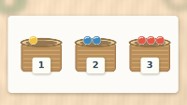
For 2-4 players, use three buckets or baskets labeled 1, 2, and 3; three beanbags or sock balls per player. Put three buckets or baskets at safe distances and label them 1, 2, and 3. Each player tosses three soft sock balls, adding the points for successful throws. Misses score zero. Compare totals together and discuss which throws contributed the most. Try five short rounds.
To change the challenge, label buckets 5, 10, and 20 for older children, or play to reach exactly 10. This game practices small-number addition and comparing totals. Suggested ages: 4-7.
12. Treasure Grab Relay
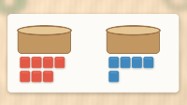
For 2-4 players, use 20-30 large soft blocks or linking cubes in a central pile, and one basket per player. Players take turns walking quickly to collect one large block at a time. When the pile is empty, estimate each basket's total, count the blocks, and compare collections: which has more, fewer, or how many more? Lay blocks in matching rows to check the difference. Keep the floor clear to prevent trips.
To change the challenge, call "swap!" mid-game so players must re-estimate a basket that isn't theirs. This game practices counting larger collections, comparing quantities, and estimation. Suggested ages: 4-7.
How to Pick the Right Game (and Keep It Fun)
Match the challenge to your child's current number understanding, not only their grade. Encourage them to explain a strategy and try a different one. The Erikson Institute's Number Sense resources emphasize meaningful comparisons and connections between quantities.
For a concept-focused explanation, return to our number sense guide. These games give families an additional way to practice those ideas.
SunStart's Guided Creative Thinking learning method emphasizes exploring first, then discussing what children notice. For hands-on materials, the Logic and 2D/3D Shapes Kit includes linking cubes, a guided workbook, and related digital lessons; the cubes can also support optional counting games with adult supervision.
FAQ: Number Sense Games, Answered
What is the best number sense game for a 4-year-old?
Try Dice Flash for noticing small dot patterns or Jump the Roll for counting actions one at a time. Start with just a few rounds and let your child stop when their attention fades.
How often should we play math games at home?
Short, enjoyable sessions can be more helpful than a rigid schedule. Repeat familiar games while adjusting the challenge, and follow your child's interest and stamina.
My child just wants to win and melts down when losing. Should we stop playing?
Not necessarily. Try a cooperative version, shorten the game, or focus on beating a previous personal score. Model how to handle disappointment without making winning the main goal.
Are these games enough, or does my child also need worksheets?
Both games and written practice can be useful. Young children often benefit from concrete materials and conversation; a simple drawing or worksheet can help them record what they found when they are ready.
About the Author — SunStart Education Team. Written by the SunStart Education Team, drawing on Start Math (思達創旭)'s Guided Creative Thinking approach. Start Math's educational work dates to 1988; its published organizational history records more than 400 sets of teaching aids and lesson plans. Start Math: Organizational History