



- Nov 17, 2026
- Learning Topics
2D and 3D Shape Sorting Activities for Preschool and Kindergarten
Shape sorting activities help children notice attributes and make decisions using a rule: curved boundary or straight sides, four sides or three, a flat face or a rounded surface. This guide offers 10 activities for preschool and kindergarten, from paper-shape sorting to simple tests with everyday 3D objects. Encourage children to explain their grouping rather than only naming shapes. Suggested ages indicate a starting level, not a deadline.
This page focuses on activities. For definitions and illustrations of 2D and 3D shapes, begin with our parent guide to 2D shapes and 3D shapes.
Choose an Activity
Choose a playful challenge that fits your child. Each activity below includes a visual example and a simple way to explore the idea together.
| 01 Two-Rule Sorting | 02 Side-Count Sorting | 03 Paper Shape Puzzle |
| 04 Feely Bag Mystery | 05 Ramp Test | 06 Recycling Solids |
| 07 Flat vs Solid Sort | 08 2D vs 3D Hunt | 09 Solid Face Match |
| 10 Build-It Challenge |
What Shape Sorting Actually Teaches
Sorting is an early form of logical classification: children look for an attribute, select a rule, and explain a decision. The Erikson Institute's early math ideas describe sets as important foundations for young children's mathematical thinking. Try sorting the same collection in two different ways to show that the rule matters.
Start Math educators have observed that children sometimes identify a shape by how it looks at first glance, even when they have not checked its defining features. Turning a triangle, tracing its sides, or comparing a box with a cube can prompt a richer explanation than simply naming the shape.
A child may know the name of a triangle but still need practice noticing its three straight sides. Encourage touching, tracing, rotating, and comparing. This child-led, language-rich exploration is consistent with NAEYC's developmentally appropriate practice framework. Supervise the use of blocks and keep very small objects or sharp craft materials away from young children.
2D Shape Sorting Activities
1. Two-Rule Sorting Mats (ages 3-5)
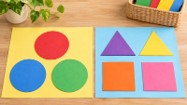
Set out two paper sorting mats, marked "curved boundary" and "straight sides," plus large paper circles, ovals, triangles, squares, rectangles, and hexagons. Put one shape on a mat and describe why it belongs there. Let your child sort the others and explain the rule. Keep the first round to circles and polygons, then add more shapes. Next, try separate mats for "3 sides," "4 sides," and "more than 4 sides."
To extend the conversation, ask: "How do you know it goes there? Can you find another shape that belongs with it?"
2. Side-Count Sorting Mats (ages 4-6)
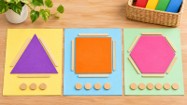
Set out three paper mats labeled 3, 4, and 6; large paper triangles, squares, rectangles, and hexagons. Place the mats on a table. Have your child trace and count the straight sides of each shape, then put it on the matching mat. Add a tilted square or a long, narrow triangle to show that turning or stretching a shape does not change its number of sides.
To extend the conversation, ask: "This triangle looks different from that one — why do they belong together?"
3. Paper Shape Puzzle Sort (ages 3-5)
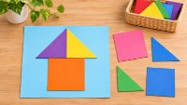
Set out large paper circles, squares, and triangles, plus three labeled sorting mats. Sort the paper shapes by the number or type of sides. Use two matching right triangles cut from a paper square to reassemble the original square, or combine shapes to make a picture. Ask your child which attributes stayed the same and which changed. Keep scissors for adult preparation only.
To extend the conversation, ask: "How did you decide where this shape belongs? Can two triangles make a larger shape?"
3D Shape Sorting Activities
4. Feely Bag Mystery Sort (ages 4-6)
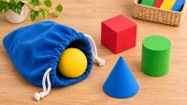
Set out a cloth bag; a child-safe ball, cube block, cylinder block, and cone model. Hide one solid at a time in a bag. Without looking, have your child describe whether it feels curved, flat, or pointed. Reveal the object and sort it by a chosen attribute, such as "has a curved surface" or "has flat faces." Ask whether some objects fit more than one description.
To extend the conversation, ask: "What did your fingers notice first — a flat part, a point, or a curve?"
5. Roll, Slide, or Stack? Ramp Test (ages 4-6)
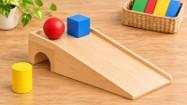
Set out a stable, low ramp made from a board and a pillow; a ball, a cylindrical container, a box, and a cone model. On a simple chart, make three columns: rolls, slides, and stacks. Test each object with adult supervision and mark every behavior it can show; some solids belong in more than one column. Turn the cylinder onto its end and onto its side to compare what changes.
To extend the conversation, ask: "Can an object both roll and stack? What changes when we turn the cylinder?"
6. Recycling Bin Solid Sort (ages 3-6)
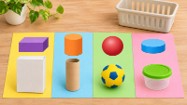
Set out clean, dry and safe packaging such as a cereal box, a cylindrical container, a paper-towel tube, and a large ball. Sort by shape into rectangular prisms, cylinders, and spheres. Include a cube only if you actually have a box with six equal square faces. Compare surfaces and count how many of each solid you find at home.
To extend the conversation, ask: "How is a rectangular cereal box different from a cube? Which objects have curved surfaces?"
Mixed 2D and 3D Sorting Activities
7. Flat Picture or Solid Object? Two-Hoop Sort (ages 3-5)
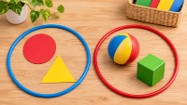
Set out two floor mats or tape circles, large paper pictures of circles, triangles, and squares, and several large solid blocks or balls. Use one area for pictures representing 2D shapes and another for 3D objects. Explain that real paper has a little thickness, but the drawn outlines represent flat, two-dimensional shapes. Sort the models, then find a flat face on a 3D object that matches a 2D drawing.
To extend the conversation, ask: "Which 2D shape can you find on the face of this box? Is the whole box flat?"
8. 2D vs 3D Scavenger Hunt (ages 4-6)
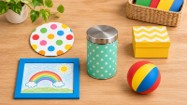
Set out a simple checklist with six picture boxes — circle, square, triangle, sphere, cube, cylinder — and a pencil. Look for a circular clock face, a rectangular window face, or a triangular decoration, then for a ball, a cube-shaped block, and a cylinder-shaped container. Explain that faces and drawings can be described using 2D shapes, while the full objects occupy 3D space.
To extend the conversation, ask: "Is the window opening rectangular, and is the whole window a flat drawing or a real object with thickness?"
9. Face Match: 3D Solids and 2D Outlines (ages 4-6)

Set out a cube block, a rectangular box, a cylinder, paper, and a marker. Trace a flat face of each solid onto paper: a square from the cube, a rectangle from the box, and a circle from the end of the cylinder. Have your child match each solid to the outline it can make. Explain that a sphere has no flat face to trace.
To extend the conversation, ask: "Which solids can leave a square, rectangle, or circle outline? Why can't we trace a flat face of a ball?"
10. Build-It Challenge (ages 5-7)
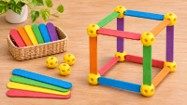
Set out large blunt craft sticks or thick paper strips, adult-prepared reusable connector putty, and cards showing a triangle, square, cube, and pyramid. Make a flat square frame with four sticks. Then ask what additional edges and corners a cube frame would need. Build with adult guidance, compare the finished models, and sort them as 2D outlines versus 3D frameworks. Use age-appropriate pieces and avoid toothpicks or small marshmallows.
To extend the conversation, ask: "How many edges and vertices does the cube framework need? How does it differ from the square outline?"
Extend Shape Thinking with the SunStart Linking Cubes Kit
Household materials are enough for the 10 activities above. Families who want a structured extension can explore the SunStart Logic and 2D/3D Shapes with Linking Cubes Kit. The published product description lists 100 linking cubes in ten colors, one full-color guided workbook, and related digital learning units. It does not list separate shape-sorting mats or standalone shape-card sets.
The kit explores patterns, basic shapes, 2D-to-3D construction, and spatial reasoning through an approach that pairs exploration with parent guidance. Read about the broader hands-on teaching aids or the Pre-K program for ages 4-5 for related learning ideas.
FAQ
What age should kids start shape sorting activities?
Many preschoolers can begin sorting familiar shapes by one clear attribute, but children develop at different rates. Begin with just a few large shapes, then introduce a second rule when the child is ready.
Should I teach 2D shapes or 3D shapes first?
Explore real 3D objects and simple 2D pictures together. A ball or box offers a hands-on way to notice shapes; a drawing helps children name and compare flat outlines. Neither needs to come first for every child.
My child just dumps the shapes instead of sorting. What should I do?
Start with free exploration. Then choose only four or five large shapes and one obvious rule. Model one example and offer the next shape. Try again later if your child is not interested in sorting yet.
How long should a shape sorting activity last?
A few focused minutes can be enough. Follow the child's attention and repeat familiar activities with a new sorting rule when they are ready.
About the Author — SunStart Education Team. Written by the SunStart Education Team, drawing on Start Math (思達創旭)'s Guided Creative Thinking approach. Start Math's educational work dates to 1988; its published organizational history records more than 400 sets of teaching aids and lesson plans. Start Math: Organizational History