


- Nov 17, 2026
- Learning Topics
15 Pattern Recognition Activities for Kids That Build Logical Thinking
Pattern recognition helps children notice what repeats, identify a rule, and predict what could come next. Stripes, sounds, colors, shapes, and growing towers all offer opportunities to observe, test ideas, and explain reasoning. These 15 pattern recognition activities use everyday materials and are arranged from simple repeating patterns to more challenging growing and number patterns. Suggested ages are flexible starting points, not milestones or deadlines.
Why do patterns matter? The Erikson Institute Early Math Collaborative describes patterns as relationships governed by rules, found in objects, sounds, actions, and numbers. Children can move from copying a repeating unit to extending it, finding a mistake, and creating their own rule. This kind of observation and explanation also connects naturally to number sense and early mathematical reasoning.
Start with a visible AB pattern such as red-blue-red-blue. Show the repeating unit at least twice, and preferably more, before asking a child to continue it. Supervise all activities, use large age-appropriate pieces, and keep beads, coins, loose buttons, and strings away from children who may mouth objects.
Choose an Activity
Choose a playful challenge that fits your child. Each activity below includes a visual example and a simple way to explore the idea together.
| 01 Snack-Time Pattern Trays | 02 Clap-stomp sound patterns | 03 Sidewalk pattern hunt |
| 04 Tabletop Color Patterns | 05 Laundry Pattern Lines | 06 Block pattern trains |
| 07 Design Your Own Pattern Strip | 08 Fix-the-mistake patterns | 09 Sound-and-Shape Match |
| 10 Same pattern, new stuff | 11 What's my secret rule? | 12 Staircase growing patterns |
| 13 Skip-count hopscotch | 14 Secret Symbol Patterns | 15 Hundred-chart treasure hunt |
Everyday Life Pattern Activities (Ages 3-5)
Use everyday materials to help children notice rules in familiar settings.
1. Snack-Time Pattern Trays
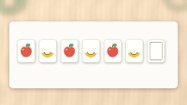
Lay out a tray and prepare large picture cards showing two different snacks, such as apples and bananas. Start with apple-banana-apple-banana, invite your child to add the next card, and then try a new A-A-B rule. Paper drawings or large play pieces work well; avoid stringing edible items. If you use real food, prepare and supervise it appropriately for the child.
Suggested ages: 3-4. | Thinking focus: Recognizing, describing, and extending a repeating unit.
2. Clap-stomp sound patterns
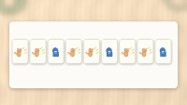
No special materials are needed. Clap-clap-stomp and repeat the full unit several times. Ask your child to copy the rhythm and then predict what comes next. Invite them to invent a new sound pattern and teach it back to you.
Suggested ages: 3-5. | Thinking focus: Hearing and reproducing a repeating rule with sound and movement.
3. Sidewalk pattern hunt
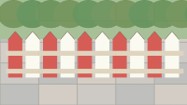
Take a supervised walk and look together for repeated arrangements, such as alternating fence colors or stripes on an awning. Ask your child to name the part that repeats and predict what might come next. Some rows of objects are simply similar, not repeated in a clear rule, so invite the child to explain the pattern they see.
Suggested ages: 3-5. | Thinking focus: Transferring pattern thinking from toys to the real world; naming the repeating unit.
4. Tabletop Color Patterns
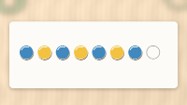
Gather two colors of large paper napkins, paper coasters, or placemats. Arrange a row of paper coasters in an AB pattern across a table. Repeat the pattern three times, leave one position empty, and ask your child which color belongs there. When ready, try AAB and let your child invent a pattern for you to complete.
Suggested ages: 3-5. | Thinking focus: Applying a consistent rule and checking whether an item fits.
5. Laundry Pattern Lines
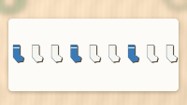
Gather several clean socks in two colors, laid flat on the floor or a table. Create a repeating pattern with full-sized socks, such as dark-light-light, dark-light-light. Ask your child to continue it and explain what repeats. Mix the socks and invite your child to rebuild the pattern in a different order.
Suggested ages: 3-4. | Thinking focus: Discovering, extending, and communicating a repeating pattern.
Hands-On Pattern Games (Ages 4-6)
These activities move from copying a pattern to building, correcting, and translating a rule. For the role of physical materials, see SunStart Hands-On Teaching Aids.
6. Block pattern trains
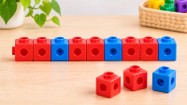
Gather building blocks or interlocking bricks in 2-3 colors. Build a short "train" with a clear pattern — red, red, blue, red, red, blue — and say the colors as you point. Ask your child to add the next four cars. When that is easy, start a harder pattern (ABC or AABB).
Suggested ages: 4-5. | Thinking focus: Identifying the repeating unit and extending it into more complex structures.
7. Design Your Own Pattern Strip
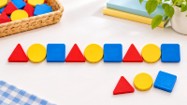
Gather large paper shapes in two or three colors and a paper strip with empty spaces. Let your child choose a repeating rule, such as red triangle-yellow circle-blue square. Have them place or draw shapes across the strip, repeating the full unit at least three times. Ask them to explain the rule so you can continue it. Make one deliberate error and invite them to correct it.
Suggested ages: 4-6. | Thinking focus: Creating a pattern, not copying one — generating a rule instead of following it.
8. Fix-the-mistake patterns
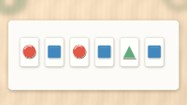
Gather large shape cards: red circles, blue squares, and one green triangle. Lay out red circle-blue square-red circle-blue square-green triangle-blue square. Ask which piece breaks the red-blue AB rule, and invite your child to replace it with the correct shape. Then ask them to create a different error for you to find. Begin with a pattern repeated at least twice before introducing the mistake.
Suggested ages: 4-6. | Thinking focus: Error detection — comparing what is against what should be, the core habit of mathematical checking.
9. Sound-and-Shape Match
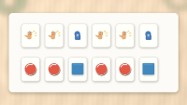
Gather two large shape cards and space to clap and tap. Make a clap-clap-tap pattern and repeat it three times. Show how the same A-A-B rule can be represented by circle-circle-square cards. Let your child switch between cards, claps, and taps, then invent their own sound-and-shape pattern.
Suggested ages: 4-6. | Thinking focus: Identifying the same repeating structure across sounds and visuals.
10. Same pattern, new stuff
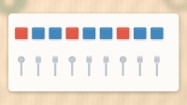
Gather two different sets of objects — blocks in two colors, plus spoons and forks. Build a red-blue-blue pattern with large blocks and repeat it three times. Ask your child to create the same ABB rule with spoons and forks: spoon-fork-fork, repeated. Explain that the objects change but the structure stays the same.
Suggested ages: 5-6. | Thinking focus: Representing one pattern rule with different materials, a step toward abstract reasoning.
Advanced Pattern Challenges (Ages 5-8)
These challenges introduce growing and number patterns. A SunStart kindergarten-level program also emphasizes reasoning, observation, and problem-solving, although children may approach these challenges at different ages.
11. What's my secret rule?
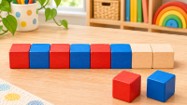
Gather large red and blue cards or blocks. Lay out red-blue-red-blue-red-blue, leaving two spaces empty. Ask your child to find the hidden AB rule and predict the next two colors. Test the prediction, then swap roles so your child invents a secret repeating rule.
Suggested ages: 5-7. | Thinking focus: Inferring a repeating rule from examples, making and checking predictions.
12. Staircase growing patterns
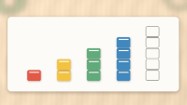
Gather about 20 large blocks or linking cubes suitable for the child's age. Build a staircase: a tower of 1, then 2, then 3. Ask, "How tall is the next step? How do you know?" Have your child predict the fifth step, then build and check.
Suggested ages: 5-7. | Thinking focus: Growing patterns — seeing change as a rule ("each step adds one") and predicting beyond what is visible.
13. Skip-count hopscotch
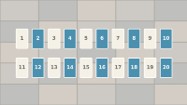
On a safe, level driveway or patio, draw a chalk number path from 1 to 20. Invite the child to point to or step on 2, 4, 6, and 8, then ask what changes each time. When the child is ready, try the same activity with numbers increasing by five. Jumping is optional; pointing works too.
Suggested ages: 5-7. | Thinking focus: Number patterns in motion — skip counting as a rule, the foundation of multiplication.
14. Secret Symbol Patterns
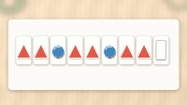
Gather paper and crayons or large shape stamps. Draw a repeated sequence of symbols, such as triangle-triangle-circle, triangle-triangle-circle. Ask your child to identify the rule and predict the missing symbol in a new sequence. Then have them make a secret sequence for you to decode.
Suggested ages: 6-8. | Thinking focus: Reading and creating repeating rules using abstract symbols.
15. Hundred-chart treasure hunt
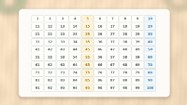
Gather a printed hundred chart (10x10 grid of 1-100) and two crayons. Have your child color every number ending in 0, then step back and ask what they see (a straight column). Next, color the numbers as you skip count by 5s together, and look again. Finish by having them predict what the 2s pattern will look like before trying it.
Suggested ages: 6-8. | Thinking focus: Discovering structure inside the number system — numbers are organized, not random.
Guided Questions: How to Talk During Pattern Play
Continuing a pattern is one skill; explaining the rule is another. Invite children to tell you what repeats, why they chose the next item, and how they would test a different rule. This question-led approach fits SunStart's Guided Creative Thinking learning method, which emphasizes exploration before explanation.
In Start Math classrooms, teachers have observed that some children can extend a repeating pattern correctly before they can explain the rule behind it. Rather than supplying the answer, educators invite children to point to the repeating unit, predict what follows, and describe why their choice fits.
Keep these in your back pocket, in rough order of difficulty:
-
"What do you notice?" — the open door; any answer is a win.
-
"What comes next? How do you know?" — moves from guessing to justifying.
-
"Can you say the pattern out loud?" — naming makes it concrete.
-
"Where does the pattern start over?" — isolates the repeating unit.
-
"Can you make the same pattern with different things?" — pushes toward abstraction.
-
"Can you invent a pattern that would trick me?" — hands over ownership.
After asking a question, leave time for your child to think. If they hesitate, point to the repeated unit or model the first step, then let them try again.
Start Small, Stay Playful
Choose one activity and adjust the challenge to your child's interests. When they are ready to explore shapes and structures, the SunStart Logic and 2D/3D Shapes Kit combines linking cubes with a guided workbook and digital learning activities. It is an optional extension, not a requirement for the games above.
FAQ
At what age do kids start recognizing patterns?
Children begin noticing regularities early, but the ability to copy, extend, create, and explain repeating patterns develops at different rates. Begin with a short AB pattern and increase complexity when your child is ready.
Is pattern recognition really math, or just play?
Pattern work is part of early mathematics because it involves rules, relationships, and predictions. It also gives children opportunities to explain ideas and reason logically through play.
My child can continue patterns but can't explain them. Should I worry?
Not necessarily. Recognizing a pattern and explaining its rule are related but different tasks. Model your own reasoning and ask one simple follow-up question without making it a test.
What's the difference between a repeating pattern and a growing pattern?
A repeating pattern cycles through a unit such as red-blue-red-blue. A growing pattern changes according to a rule, such as towers of 1, 2, 3, and 4 blocks. Children can explore both with support and age-appropriate materials.
About the Author — SunStart Education Team. Written by the SunStart Education Team, drawing on Start Math (思達創旭)'s Guided Creative Thinking approach. Start Math's educational work dates to 1988; its published organizational history records more than 400 sets of teaching aids and lesson plans. Start Math: Organizational History